Hoya australis subsp. rupicola
A shrubby or scrambling subspecies with very succulent, hairy leaves, recorded on sandstone outcrops and cliffs.
Its documented growth habit and rocky habitat make this a distinct subspecies profile. Habitat observations do not establish a watering or light prescription for cultivated plants.
Overview
Hoya australis subsp. rupicola is a botanical subspecies with shrubby or scrambling growth. In Flora of Australia, Paul Forster and David Liddle describe very succulent, densely hairy leaves; the species account describes cream flowers with red beneath the central crown. Ken Hill named it Hoya rupicola in 1988, and Forster and Liddle placed it under Hoya australis in 1991. Their flora treatment records it from the Kimberley in Western Australia and much of the monsoonal Northern Territory.
Photo Gallery
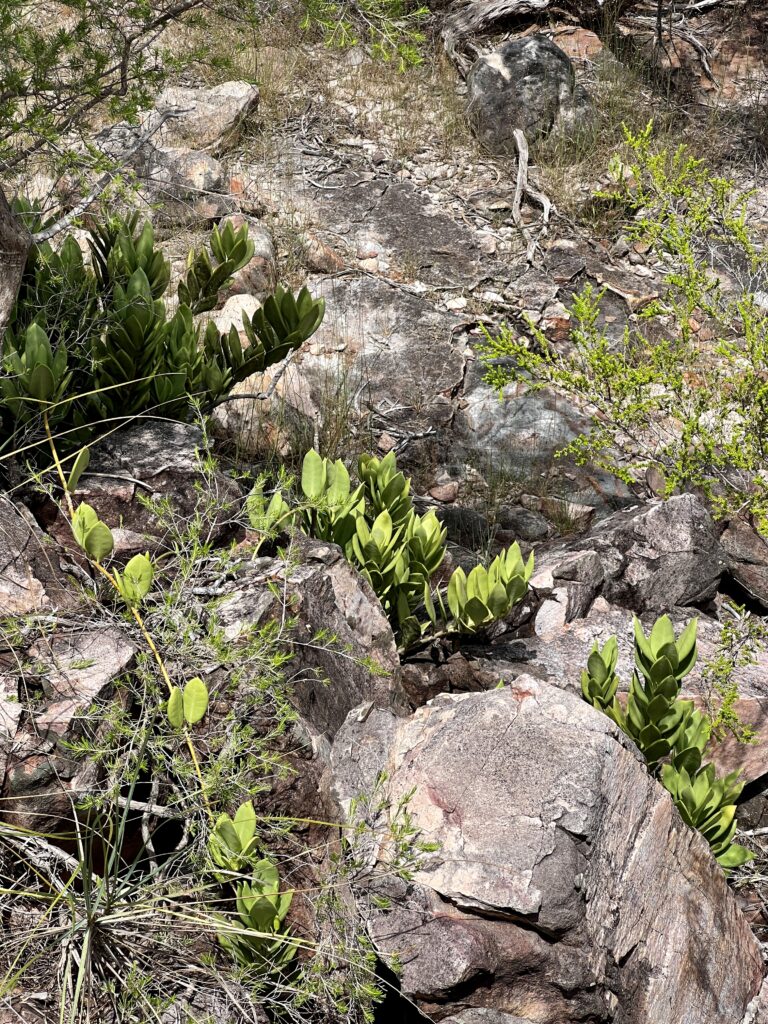 Hoya australis subsp. rupicolaView photo detailsClose photo details
Image source · Rights and reuse terms

Plant identified by the photographer as Hoya australis subsp. rupicola, growing on a cliff face in Litchfield National Park, Northern Territory,18March2022. Photo:JP4294,CC BY-SA4.0.
Photographer or creator: JP4294
Identification basis: Identified by the photographer as Hoya australis subsp. rupicola; field photograph at Litchfield National Park. No independent voucher or specimen authentication inferred.
Rights and reuse: CC BY-SA 4.0; attribution and share-alike required. Full frame; WordPress resized the web copy. No crop or retouching.
Image record: WP-MEDIA-1020
What We Know
- Flora of Australia describes a small shrub or scrambler that does not climb, with densely hairy, very succulent leaves up to 15 cm long. The leaf margins are not strongly rolled under.
- The flora records sandstone outcrops and cliff lines. The approved field photograph shows a plant identified by its photographer as rupicola on a cliff face in Litchfield National Park; it illustrates one site, not a controlled cultivation comparison.
- The Australian account reports January–February flowering. Those observations do not establish a flowering calendar for plants grown elsewhere.
- Kew’s Plants of the World Online accepts Hoya australis subsp. rupicola and treats Hoya rupicola, published in 1988, as its earlier name.
What We Are Still Learning
Which cultivated rupicola plants have documented wild-origin or voucher-linked histories?
What would help: Original labels, supplier and propagation records, accession or voucher identifiers, and leaf and flower photographs of the same plant.
What cultivation studies test the significance of its succulent leaves and rocky habitat?
What would help: Published studies using identified material, with measured growing conditions, methods, sample sizes and comparisons. A habitat photograph alone cannot establish an optimum watering or light level.
Research and Sources
Help answer this profile’s questions
Help connect cultivated rupicola plants to documented accessions or published cultivation studies. Original labels, voucher records and carefully sourced comparisons would help answer this profile’s questions.
Contribute evidence for this profile