Preserving the world’s knowledge about Hoya
Hoya Research Library
Explore Hoya names, cultivation, history, people, publications, and the evidence behind what we know.
Search a plant, person, publication, or topic to find the records and sources behind it. Reviewed answers to research questions are in development.
Library at a glance
How much is there to explore?
Start with a plant, follow a publication, or meet the people behind a name.
Live totals from the public collections. Hoya pages and Growing Profiles are counted separately; these are available records, not a claim that every research question is settled.
Why this Library
Follow the evidence
The Library connects what a source actually said to today’s interpretation. When a name, identification, or growing claim is uncertain, that uncertainty belongs in the story.
Trace the source
Find the publication, person, or observation behind a statement when its record is available. See how we track source gaps.
Keep the history
Read historical usage in its own context alongside later interpretations.
Improve the record
Growers and researchers can submit evidence for review. A contribution does not directly edit a Hoya page.
Browse the Library
Choose a path into the collection
Start with a plant, the material that documents it, or the people connected to its history.
Explore Hoyas
Browse the Hoya archive and follow names, forms, growing profiles, and related records where available.
Open the Hoya archive →Sources
Explore publications, historical documents, journals, and other evidence in the Source Library.
Open the Source Library →Directory
Meet the people, societies, nurseries, herbaria and other organizations connected to Hoya knowledge.
Open the Directory →Images
Look closely at flowers, foliage and historical illustrations, with documented identifications, credits and reuse terms.
Open the Images index →Concepts
Explore recurring ideas in Hoya biology and cultivation, from familiar grower terms to the evidence behind them.
Open the Concepts index →Looking for an older name? Search the collection above or browse the Hoya and Source records.
Research questions
Questions keep the research moving
Identity, provenance, and historical names often need more than a quick answer. A dated record or a well-documented observation can help define the next question.
Use our contribution and contact form to ask a question, suggest a research topic, or share evidence that could help improve a Library record.
Ask a question or share a suggestion →Look what a Hoya can lead you to
A little more to discover
A flower shape, a historical name, a familiar leaf: each can open a different trail through the Library. Follow these findings into the research behind them.
Look a little closer
One name, two publication dates?
Hoya multiflora stands out for its many-flowered clusters of strongly reflexed blooms, which create its distinctive shooting-star appearance. Its publication history is also instructive: Blume named it in 1823 and provided a fuller treatment in 1826, a distinction later sources have sometimes blurred.
Follow the story and its sources →Look a little closer
Is a heart-shaped leaf enough?
Hoya krohniana was described by Dale Kloppenburg and Monina Siar in 2009. Their account describes small, opposite, heart-shaped deep-green leaves and flowers with hairy, rolled-back petals. The plant was obtained through cultivation; its authors thought it came from the Philippines. Kew currently accepts the species and lists the Philippines as its native range. Identifying a cultivated plant requires more than a heart-shaped leaf.
Follow the story and its sources →Look a little closer
Why do lacunosa leaves look quilted?
Hoya lacunosa is a species that creeps or climbs with slender, rooting stems, fleshy leaves marked by sunken areas between the veins, and clusters of small, fragrant, pale flowers with curled-back petals and velvety hairs. Carl Ludwig Blume published its name in the 1820s; Kew cites 1827. Its native range extends from southern Myanmar through western and central Malesia, including Java, Sumatra, Borneo, the Malay Peninsula, Thailand and the Philippines.
Follow the story and its sources →Featured Hoya
Hoya multiflora
Hoya multiflora is an accepted species with a shrub-like, non-climbing habit, narrow leaves, and clusters of strongly reflexed flowers that give it an unusual shooting-star appearance. Blume published the name in 1823 and provided a fuller treatment in 1826.
Explore Hoya multiflora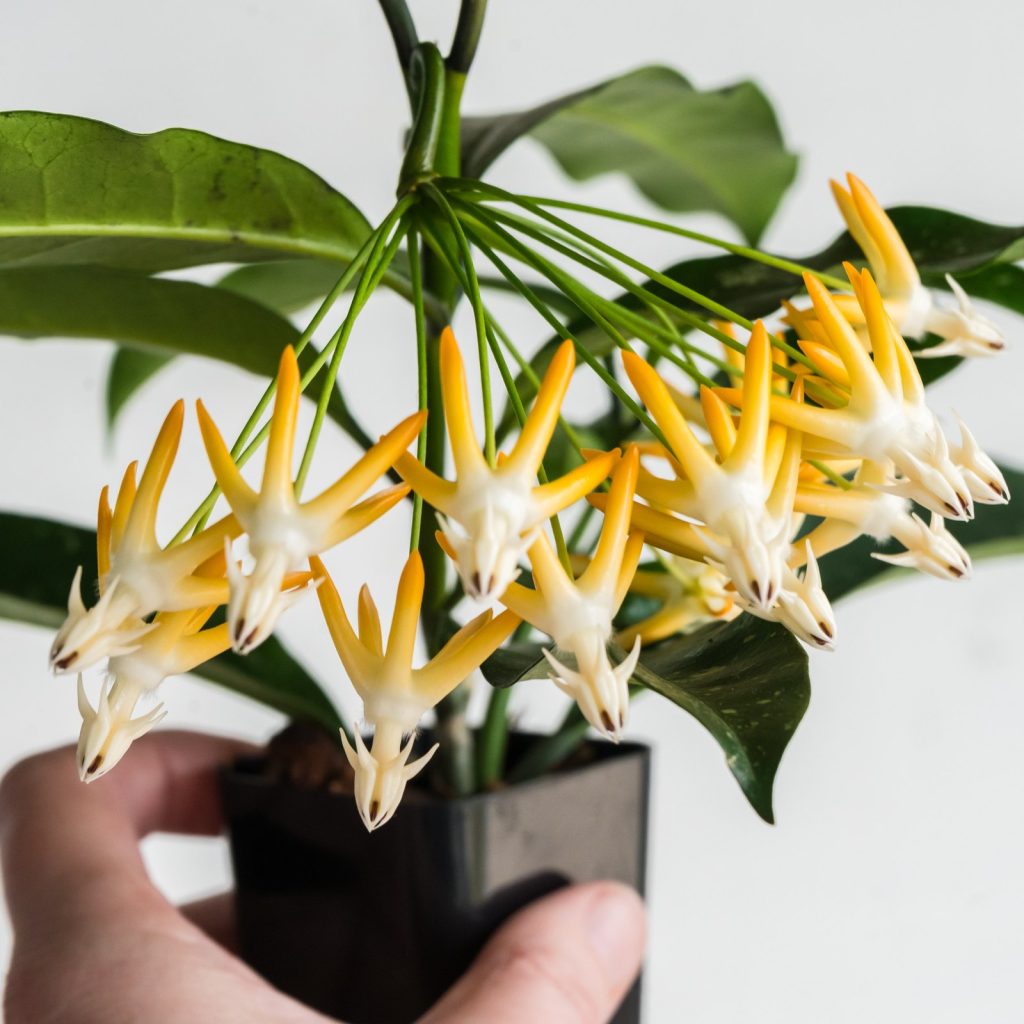
Photo details
Flowers of a cultivated plant identified by its owner as Hoya multiflora from a collection label, photographed January 10, 2024.Photo: Rebecca Baron. © Rebecca Baron. Reuse requires permission from Rebecca Baron.
Identified by the contributor from a collection label; source plant and label have not been independently verified.
Research and discovery
Follow the work behind the pages
Explore the source collection
Read publication records, original-source links, and notes explaining how each source is used.
Browse sources →Trace a publication series
Our Hoyan catalog distinguishes the issues in our research collection from missing copies and material available to read online.
Explore The Hoyan holdings →Meet the people behind the research
Follow authors and editors to their publications and documented contributions.
Browse the Directory →Understand recurring terms
Concept records explain terminology and connect it to evidence, examples and remaining questions.
Explore Concepts →Contribute to the Library
Have evidence to add?
Photographs, cultivation observations, source leads, historical materials, and corrections can improve the Library. Tell us what you have and where it came from.
Contribute evidenceWhat happens next
Your submission enters a private review queue. Its identity, provenance, rights, and relevance are checked before eligible material is connected to public records. Our single contribution and contact form accepts information, source leads, questions, and original photographs for private review. Choose your reason to see the relevant fields.
How the Library works
From source to useful page
Records preserve what a source says. Reviewers compare the evidence and explain what it supports, what it does not settle, and why it matters to a reader.
- CollectDocument a source or observation with its origin and rights.
- ReviewCheck identity, context, conflicting evidence, and uncertainty.
- PublishConnect approved findings to Hoya, Source, and Person pages so readers can follow the trail.