Hoya multiflora
Hoya multiflora is an accepted species with a growth habit and flower shape that can look unusual beside more familiar trailing or twining hoyas.
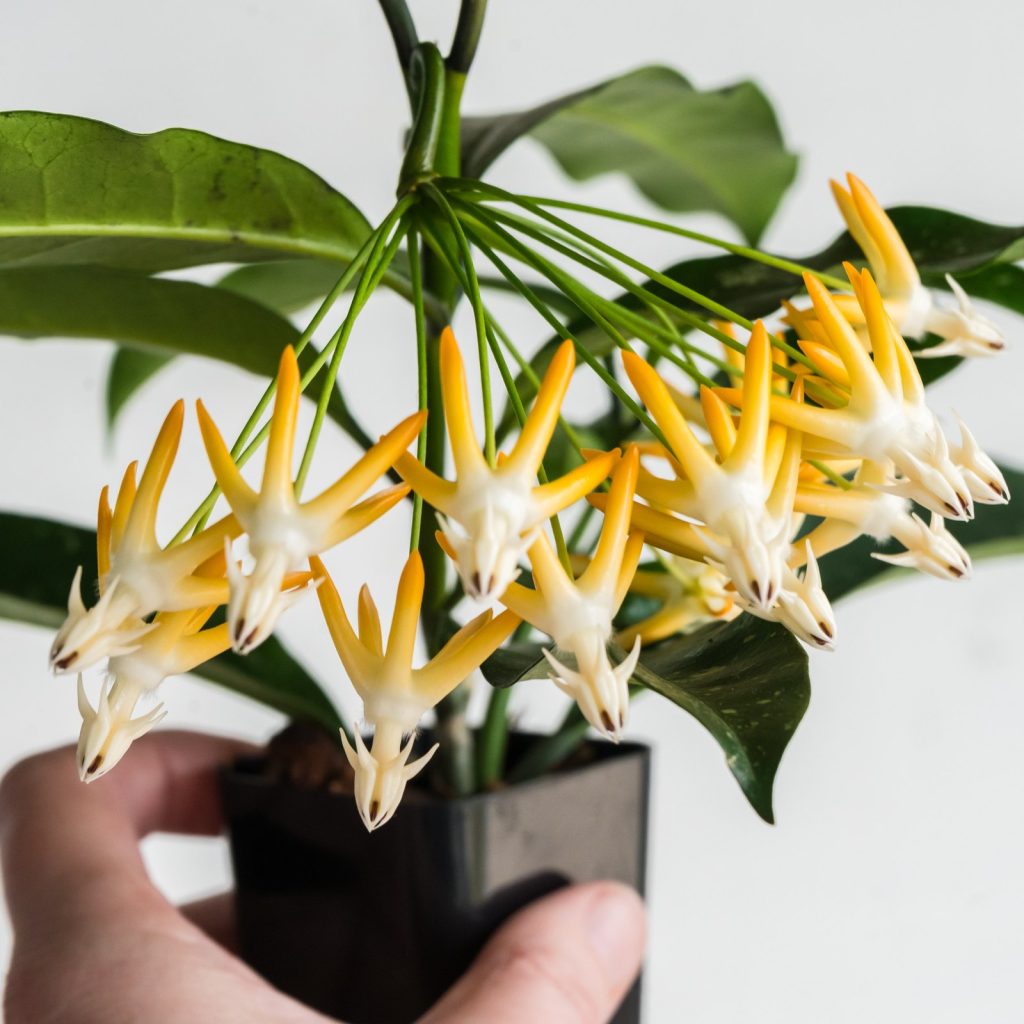
Photo details
Flowers of a cultivated plant identified by its owner as Hoya multiflora from a collection label, photographed January 10, 2024.
Photo: Rebecca Baron
Reuse: © Rebecca Baron. Reuse requires permission from Rebecca Baron.
Identification: Identified by the contributor from a collection label; source plant and label have not been independently verified.
Overview
Hoya multiflora is an accepted species with a shrub-like, non-climbing habit, narrow leaves, and clusters of strongly reflexed flowers that give it an unusual shooting-star appearance. Blume published the name in 1823 and provided a fuller treatment in 1826. It is native to parts of southern China and tropical Asia, including Java, Peninsular Malaysia, Borneo, and the Philippines.
Quick Facts
Taxonomic status
Accepted
Source and scope
Name first published
Blume (1823) published the name in Catalogus, p. 49. His fuller treatment followed in Blume (1826), p. 1064.
Name meaning
Multiflora means “many-flowered.”
Naming evidence and limits
The botanical reference connects the epithet with numerous flowers. Blume’s own naming intention has not been established.
High for attributed botanical-reference explanation; original author rationale unresolved
Pronunciation
HOY-ah mul-tih-FLOR-uh. An English pronunciation guide; capitals mark the stressed syllables. Other pronunciation conventions are also used.
Source and scope
Combined editorial guide: Hoya follows NC State’s genus entry; multiflora adapts Oregon State’s pronunciation of the same Latin epithet in Rosa multiflora. The rose’s plant characteristics are not applied to Hoya.
Native region
Royal Botanic Gardens, Kew lists southern China and tropical Asia, including Java, Peninsular Malaysia, Borneo and the Philippines.
Natural habitat
A rainforest epiphyte—a plant growing on other plants—often found on decaying wood in Goyder’s account.
Growth habit
Goyder (1990) describes a non-twining plant with stems reaching about 75 cm.
Leaves
Goyder (1990) describes leaves 6–20 cm long and usually 2–5 cm wide, with some reaching 8 cm wide. Blume (1826) describes somewhat leathery, hairless leaves with visible veins and a paler underside.
Sap / latex
White latex is described throughout the plant in Rahayu and colleagues’ 2010 account.
Source and scope
A species description in the paper’s introduction, rather than a measured comparison of sap among cultivated forms. It describes tissue latex, not floral nectar.
Flowers
Goyder (1990) describes clusters of up to 40 flowers with petal lobes swept sharply backward around a prominent central crown—the shape behind the shooting-star nickname.
White or cream, with pale-orange tips and sometimes pale-purple spots, as described by Goyder (1990).
Flowering period
Blume (1826) records flowering throughout the year in his historical treatment. This is a source observation, not a promise of year-round flowering in a home.
What would you add?
Photo Gallery
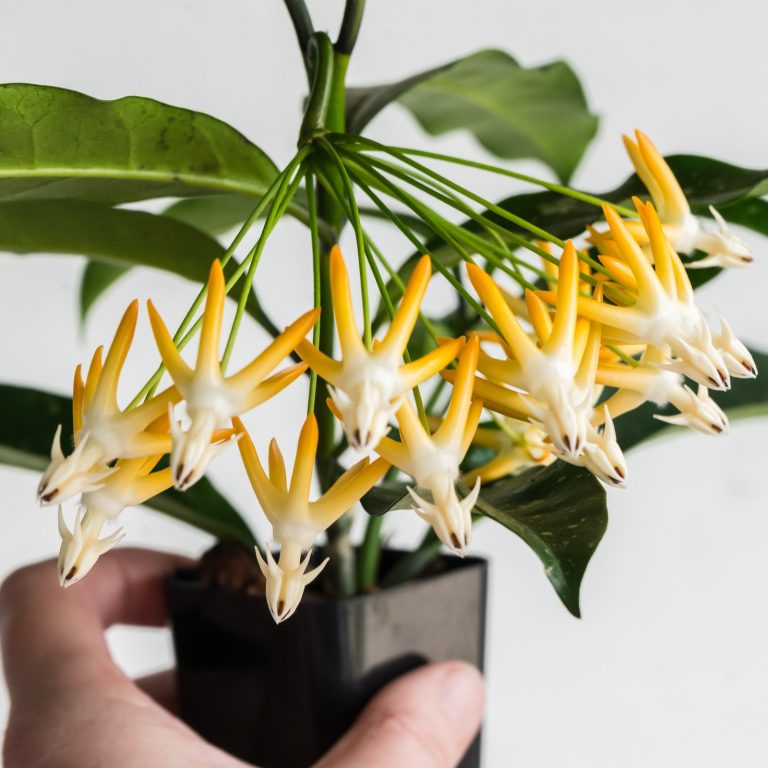 Flowers of a cultivated plant identified by its owner as Hoya multiflora from a collection label.View photo detailsClose photo details
Flowers of a cultivated plant identified by its owner as Hoya multiflora from a collection label, photographed January 10, 2024.
Photo: Rebecca Baron
Reuse: © Rebecca Baron. Reuse requires permission from Rebecca Baron.
Identification: Identified by the contributor from a collection label; source plant and label have not been independently verified.
Image record: IMG-000001
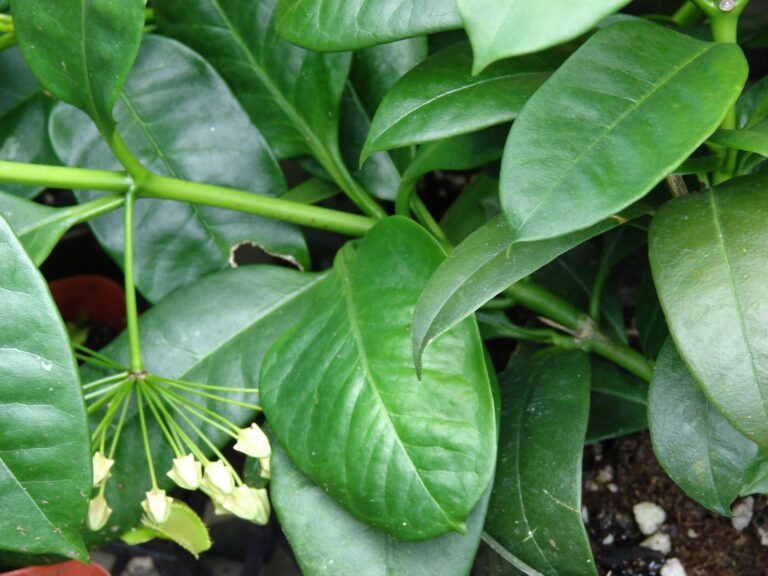 Leaves and flower buds of a cultivated plant identified by Forest & Kim Starr as Hoya multiflora.View photo detailsClose photo details
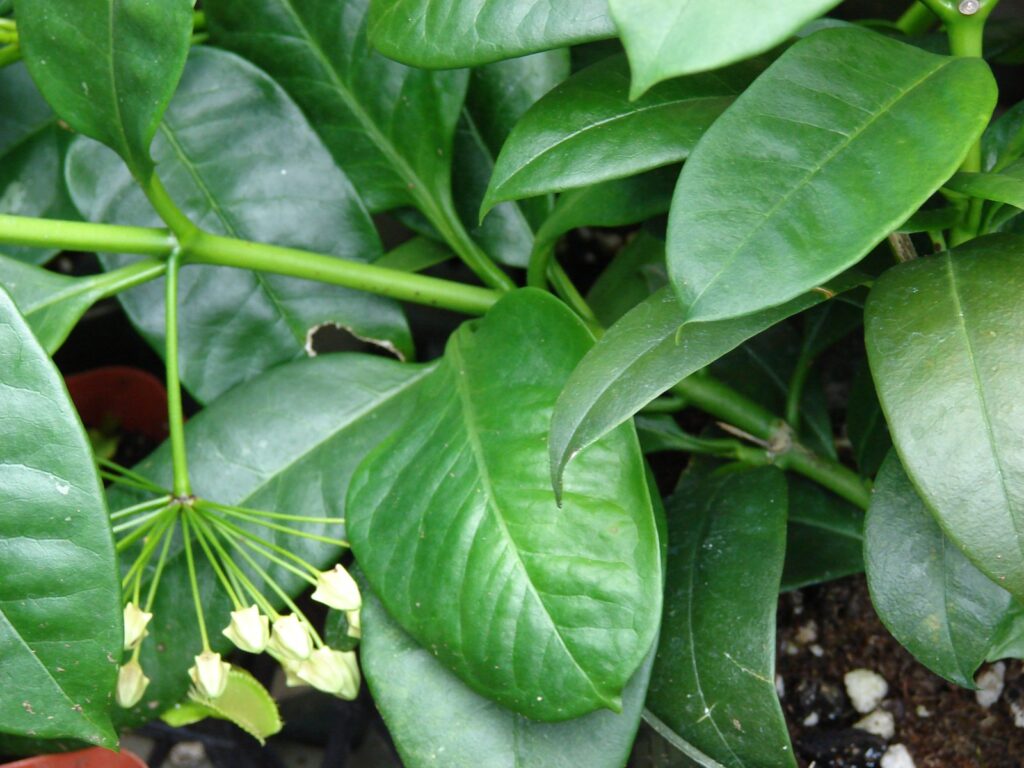
Leaves and flower buds of a cultivated plant identified by Forest & Kim Starr as Hoya multiflora, photographed at a Maui nursery on 6 September 2007.
Photo: Forest & Kim Starr
Reuse: CC BY 3.0 — https://creativecommons.org/licenses/by/3.0/ Web derivative resized/re-encoded and metadata removed; original image composition retained.
Identification: Photographers identify as Hoya multiflora; not independent specimen verification; source identification retained, no independently examined voucher.
Image source · Rights and reuse terms

Image record: IMG-000182
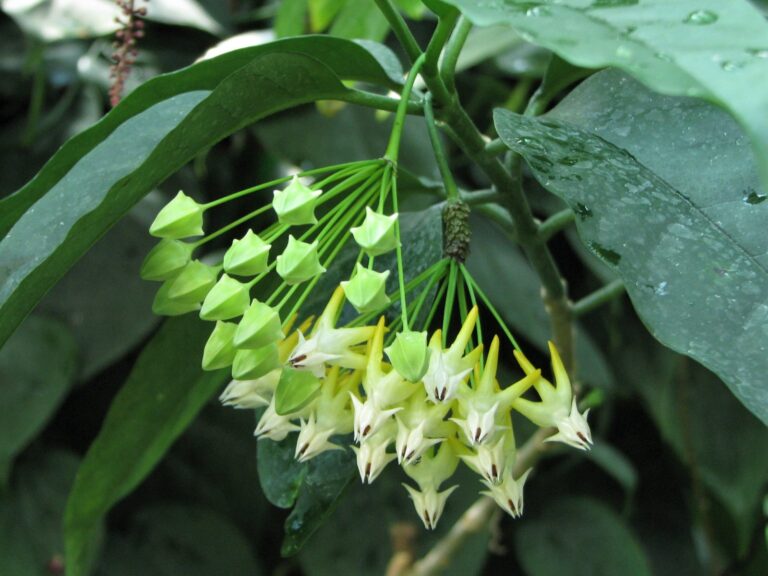 Flower buds and open flowers of a plant identified by Agnieszka Kwiecień, Nova as Hoya multiflora, cultivated at Wrocław University Botanical Garden, 1 August 2010.View photo detailsClose photo details
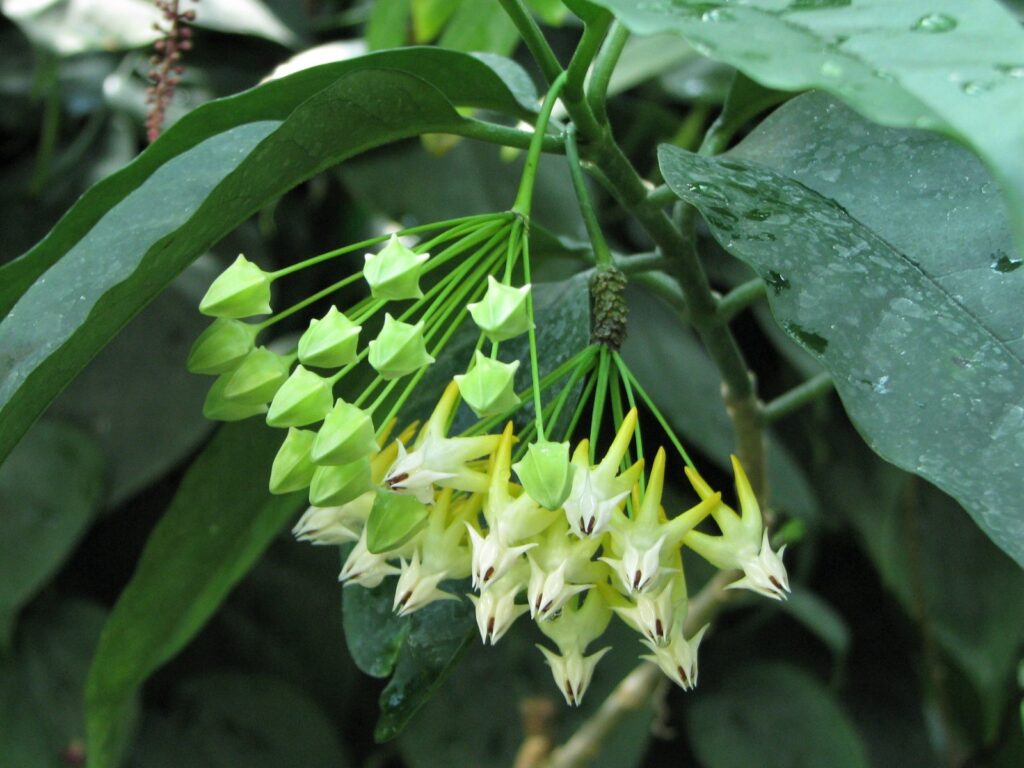
Flower buds and open flowers of a plant identified by Agnieszka Kwiecień, Nova as Hoya multiflora, cultivated at Wrocław University Botanical Garden, 1 August 2010.
Photo: Agnieszka Kwiecień, Nova
Reuse: CC BY-SA 4.0 — https://creativecommons.org/licenses/by-sa/4.0/ Web derivative resized/re-encoded and metadata removed; original image composition retained.
Identification: Creator identifies as Hoya multiflora; source identification retained, no independently examined voucher.
Image source · Rights and reuse terms

Image record: IMG-000183
Forms and Growing Profiles
Explore documented cultivated material and other selling labels. A label alone does not establish different care.
Growing Profiles
Hoya multiflora ‘WonderPhil’Registered cultivar
A registered cultivar whose originators previously used Silver and Splash as selling names.
The originators previously sold their material as Silver or Splash. That history does not identify plants sold under those words by other growers.
Other names used in cultivation
SilverIdentity unresolved
A selling label used for multiflora; the identity of the cultivated material remains unresolved.
The label is recorded in cultivation. Original labels and propagation history would help establish which plants share the same origin; appearance alone cannot establish clone identity.
SplashDescriptive label
A descriptive label for splash-marked foliage; it does not establish one cultivar or clone.
The label describes foliage markings. Keep the original label and plant’s source history when comparing material; similar markings alone do not establish a shared clone.
Mini / small form, including mini splashIdentity unresolved
Marketed as a miniature multiflora with splashy leaves; its relationship to other small forms remains unresolved.
Nurseries market a miniature plant with splashy foliage. The plain small form label may encompass other material; no clone or care distinction is established here.
Outer variegatedIdentity unresolved
Sold under a foliage-variegation description; a distinct clone and stable trait have not been established here.
A nursery sells multiflora under this foliage description. Provenance, stability and any relationship to older variegated reports remain unverified.
AH ‘Destiny’ variegataIdentity unresolved
Listed separately from multiflora albomarginata in the AH Hoya catalogue.
The catalogue lists multiflora AH ‘Destiny’ variegata as entry 630. A catalogue name alone does not establish its identity, stability, or relationship to other variegated plants.
Recorded source: AH Hoya catalogue, PDF p. 14, entries 630–631
AlbomarginataIdentity unresolved
A separate catalogue label; its relationship to plants sold as outer variegated is unresolved.
The AH Hoya catalogue lists multiflora albomarginata as entry 631. It is separate from AH ‘Destiny’ variegata in that catalogue; the listing does not establish that either is a distinct clone.
Recorded source: AH Hoya catalogue, PDF p. 14, entries 630–631
Multiflora limaIdentity unresolved
A combined marketplace label whose identity and relationship to other plants sold as Hoya lima remain unresolved.
A seller uses the combined label Hoya multiflora ‘Lima’. This documents the selling name only; it does not establish a cultivar, hybrid, or relationship to plants sold simply as Hoya lima.
Evidence-Based Growing Insights
These notes report what a source or observation says, show what can reasonably be inferred, and keep the limits visible. They are not universal care promises.
Start with filtered light
Proposed takeaway: Filtered light is a reasonable starting point; judge changes by new growth rather than aiming for a universal light number.
Evidence, reasoning and ways to respond
Rahayu et al. (2011) describe smaller, yellower leaves and restricted growth at the most strongly lit sites in their Bodogol study. Goyder (1990) also advises protection from direct summer sun in his general Hoya cultivation discussion.
These accounts support a cautious starting position with some protection from strong sun. The field study did not test window positions or grow lights, and Goyder's light advice covers hoyas generally.
Start with filtered light. If changing the exposure, make a modest change and compare successive mature leaves and growth before adjusting again.
Wild multiflora at Bodogol, plus historical guidance for hoyas; indoor conditions and cultivated plants may differ.
The observations support a cautious trial, rather than a measured indoor optimum.
No fixed lux, PPFD, shade-cloth percentage or window direction is established here. Yellow leaves alone do not diagnose excess light.
Compare leaves in context
Proposed takeaway: Record growing conditions and compare several mature leaves before treating a difference as a stable characteristic.
Evidence, reasoning and ways to respond
Rahayu et al. (2010) found differences in stems, leaves and flower clusters among plants from different Bodogol habitats. Their analysis associated the groups with canopy cover.
Appearance can vary among plants and growing environments. That makes a single leaf or photograph a weak basis for deciding that a feature is stable or that a plant represents a distinct form.
Photograph several mature leaves, keep the plant's provenance, and record its light conditions. Follow new growth over time when comparing it with another plant.
Forty-eight plants sampled from six habitat types; this was not a controlled test of the same clone under different light levels.
The source documents variation and an association with habitat. It does not separate genetic differences from environmental effects.
No proof that all differences are caused by light, that a named cultivated form is invalid, or that variegation will remain stable.
Growing topics checked and remaining questions
Some topics support practical insights; others still need observations. Share your experience using the links above or below.
- Light: Filtered light is a starting point, with the limits of field observations explained.
- Water: Moisture and drainage are considered together; there is no fixed watering calendar.
- Temperature: Temperature changes during budding are covered. Habitat temperatures do not establish an indoor minimum or maximum.
- Humidity: A published grower account supports considering air humidity separately from water in the pot.
- Substrate: The moisture-and-drainage insight is retained, with a separate rooting-medium example.
- Growth and rate: Growth-speed reports remain tied to particular plants and growing setups; no general growth rate is established for this page.
- Flowering: Flower-stalk reuse and bud stability are covered. No fixed flowering schedule is promised.
- Propagation: Cuttings are the propagation route covered here, with a published grower's rooting-medium experience.
- Seasonality: The watering insight distinguishes changing growth and weather from an automatic winter drought.
- Trait stability: Documented variation supports comparing leaves and conditions. It does not establish the stability of a named cultivated form.
- Pests: The reviewed material does not support a multiflora-specific pest treatment. Reports of root trouble do not establish a pest diagnosis.
- Root behavior: Published rooting experience is useful. No universal root-rot diagnosis, rooting time or root-pruning method is established.
What would you add?
Research
Where It Grows
Native range: Royal Botanic Gardens, Kew lists southern China and tropical Asia, including Java, Peninsular Malaysia, Borneo and the Philippines.
The locations below have published field-study records. They are examples within the range, rather than its boundaries. Open a location for survey details, including reported elevations.
Belitung Island
Study area: Belitung Island, Bangka Belitung Islands, Indonesia, including nearby Ru and Seliu islands.
Hoya multiflora was recorded at Gunung Tajam, 200 m, in mixed forest, in the paper’s small population class (1–3).
Bodogol Research Station
Study area: Named research station in Gunung Gede Pangrango National Park, West Java, Indonesia.
The cited study surveyed eleven Bodogol hiking routes and recorded H. multiflora in its sampled 700–800 m and 800–900 m elevation bands.
Why is there no map yet?
The records shown here do not yet provide reviewed coordinates precise enough for a reliable public map. Named locations can still be documented without placing a map pin.
Natural Habitat
Goyder (1990) describes Hoya multiflora growing in rainforest as an epiphyte—a plant that grows on another plant—often on decaying wood. Field studies also document it in mixed forest on Belitung and several forest habitats at Bodogol in West Java.
Rainforest growth
- Rainforest epiphyte on decaying wood (Goyder 1990 account) — Goyder's 1990 account describes Hoya multiflora as an epiphyte in rainforests, often on decaying wood. This is a broad species account; it does not locate a particular population or measure how frequently this substrate occurs.
Mixed forest on Belitung
- Belitung upper-elevation mixed forest — A source-scoped mixed-forest habitat above 100 m at Gunung Tajam and Batu Mentas. Hoya multiflora, H. scortechinii and H. coronaria were reported.
Study sites at Bodogol
- Bodogol Site 1: Maesopsis eminii–Cyathea contaminans forest — Rahayu and colleagues documented Hoya multiflora at study site 1, one of six sampled habitat sites at Bodogol. The source describes this site as Maesopsis eminii–Cyathea contaminans forest with 60.23% canopy cover.
- Bodogol Site 2: Primary mixed forest — Rahayu and colleagues documented Hoya multiflora at study site 2, one of six sampled habitat sites at Bodogol. The source describes this site as Primary mixed forest with 61.53% canopy cover.
- Bodogol Site 3: Maesopsis eminii–Calliandra calothyrsus forest — Rahayu and colleagues documented Hoya multiflora at study site 3, one of six sampled habitat sites at Bodogol. The source describes this site as Maesopsis eminii–Calliandra calothyrsus forest with 75.34% canopy cover.
- Bodogol Site 4: Schima wallichii forest — Rahayu and colleagues documented Hoya multiflora at study site 4, one of six sampled habitat sites at Bodogol. The source describes this site as Schima wallichii forest with 64.15% canopy cover.
- Bodogol Site 5: Ridge open-building mixed habitat — Rahayu and colleagues documented Hoya multiflora at study site 5, one of six sampled habitat sites at Bodogol. The source describes this site as Ridge open-building mixed habitat with 54.62% canopy cover.
- Bodogol Site 6: Altingia excelsa forest — Rahayu and colleagues documented Hoya multiflora at study site 6, one of six sampled habitat sites at Bodogol. The source describes this site as Altingia excelsa forest with 80.23% canopy cover.
Publication and naming history
- 1823 — Name first published. Carl Ludwig Blume listed Hoya multiflora in his Catalogus, on page 49.
- 1826 — Fuller description published. Blume described the plant in more detail in Bijdragen tot de flora van Nederlandsch Indië, on page 1064.
Historical names explained
Older botanical publications sometimes place this species in Centrostemma or Cyrtoceras instead of Hoya. These are historical genus names; a genus is a group of related species. The accepted name used here is Hoya multiflora.
Goyder (1990) explains that the plant’s upright growth and distinctive flowers led earlier botanists to place it in a separate genus. A botanical illustration published in 1860 appeared under the name Centrostemma multiflorum.

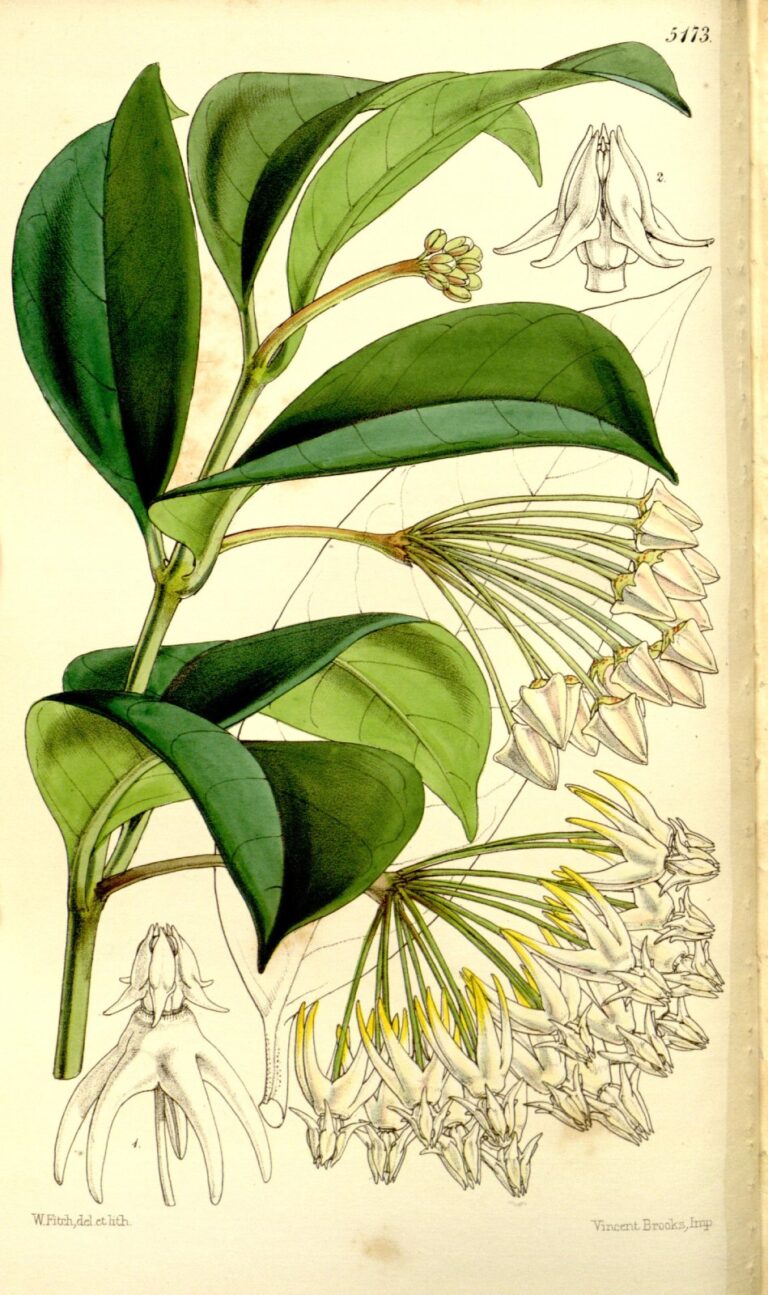
The plant, leaves and flowers
Blume’s 1826 treatment describes a shrubby climber. Goyder’s 1990 account describes a suberect, non-twining epiphyte with stems reaching about 75 cm. These are two dated descriptions; keeping them separate avoids treating either account as proof of a uniform habit in every cultivated plant.
Blume describes somewhat leathery, hairless leaves with visible veins, an oblong to lance-shaped outline and a paler underside. Goyder records leaves 6–20 cm long and usually 2–5 cm wide, including widths up to 8 cm in his description. Those measurements describe the source’s treatment; they do not identify a cultivar.
Goyder describes hanging, rounded clusters of up to 40 flowers. The corolla—the outer part of the flower—is white or cream, with pale-orange tips and sometimes pale-purple spots. Its lobes bend strongly backward around a prominent central corona, or crown. The account also reports copious nectar; it does not establish a household flowering schedule or fragrance promise.
Sources
Blume (1823) — Catalogus, Hoya multiflora p. 49
Carl Ludwig Blume · 1823 · Locator: 49
Blume (1826) — Bijdragen tot de flora van Nederlandsch Indië
Carl Ludwig Blume · 1826 wrapper; exact issue date unresolved · Vol. 16de Stuk · Locator: 1062–1065; Hoya multiflora on 1064
Hooker (1883) — Flora of British India, Vol. IV
Joseph Dalton Hooker · 1883 Hoya treatment; bound volume dated 1885 · Vol. 4 · Locator: 52–62 (Hoya account; Original PDF pp. 56–66); 62–63 (adjacent Physostelma boundary; Original PDF pp. 66–67); 52–53 (Hoya multiflora; Original PDF pp. 56–57)
Goyder (1990) — Hoya multiflora: Asclepiadaceae
David Goyder · 1990-02 · Vol. 7(1) · Locator: 3–6; cultivation on pp. 3–4; description on pp. 4–5
Burton (2002) — P. S. The Hoyan, Volume 1, Number 1
Christine M. Burton · 2002-10-01; archive capture 2022-05-29 · Vol. 1 · Issue 1 · Locator: Web pages 1–6
Fraterna (2002) — Volume 15, Number 3
International Hoya Association contributors · 2002 · Vol. 15 · Issue 3 · Locator: Issue-local pagination; physical PDF pages 49–70
Stemma — Volume 3, Issue 3 (Summer 2009)
Mark Randal and Antone Jones (editors) · 2009 · Vol. 3 · Issue 3 · Locator: 1–21
Rahayu et al. (2010) — Hoya multiflora morphology at Bodogol
Sri Rahayu; Muhammad Jusuf; Suharsono; Cecep Kusmana; Rochadi Abdulhadi · 2010-10-25 · Vol. 11 · Issue 4 · Locator: 187–193; Table 1 on printed p. 188 / PDF p. 2
Rahayu et al. (2011) — Hoya multiflora habitat at Bodogol
Sri Rahayu; Rochadi Abdulhadi; Rosniati A. Risna; Yayan W. C. Kusuma · 2011 · Vol. Konservasi Tumbuhan Tropika: Kondisi Terkini dan Tantangan ke Depan · Locator: 367–372; light and microclimate discussion on pp. 368–371
Rahayu (2013) — Growth and development of Hoya multiflora
Sri Rahayu · 2013 · Vol. Proceedings of the 7th ACSA Conference (held 2011); ISBN 978-602-17500-0-1 · Locator: 300–304; Table 3 on p. 303
Rodda & Ercole (2014) — Hoya papaschonii and the multiflora group
Michele Rodda; Enrico Ercole · 2014-08-01 · Vol. Phytotaxa 175(2) · Locator: 97–106; multiflora group on pp. 97 and 100
Rahayu, Ahmad & Rodda (2022) — Hoya of Sulawesi
Sri Rahayu; Roland P. P. Ahmad; Michele Rodda · 2022 · Vol. 74 · Issue 2 · Locator: 207–221
Tran et al. (2025) — Hoya thuhae and Vietnam checklist
T. T. N. Tran; V. C. Nguyen; L. V. Averyanov; U. S. Wook; B. V. Truong; V. K. Nguyen; T. V. Maisak; V. V. Shvanova · 2025 · Vol. 28 · Issue 4 · Locator: 144–150
Iowa State Extension — How to Pronounce Scientific Names
Aaron Steil; Iowa State University Extension and Outreach · Undated · Locator: Botanical Latin versus classical Latin; Common Pronunciations
NC State Extension — Hoya genus pronunciation
NC State Extension · Undated online account · Locator: Phonetic Spelling
NParks — Hoya multiflora name meaning
National Parks Board, Singapore · Locator: Description and Ethnobotany — Etymology
Oregon State University — pronunciation of multiflora
Oregon State University, Department of Horticulture · Undated online account · Locator: Pronunciation: Rosa multiflora; epithet only
Royal Botanic Gardens, Kew — Hoya multiflora status reference (17 September 2026)
Royal Botanic Gardens, Kew · Locator: POWO taxon summary; LSID 98577-1; reference accessed 17 September 2026