Compacta Mauna Loa
The Compacta sport described in USPP 3,054, with folded leaves, green margins and pale centres.
Keep Compacta Mauna Loa’s historical description, corrected patent and modern provenance question together; distinguish it from other variegated Compacta labels.
Overview
The 1971 patent names its plant Hoya carnosa compacta Mauna Loa and reports a sport of cultivated Compacta. It describes a compact twining plant with strongly folded leaves and a green border around a pale centre. The filed Certificate of Correction is part of the controlling record; searchable OCR and later trade-name lists require checking against it. Modern plants bearing the name need their own propagation history.
Photo Gallery
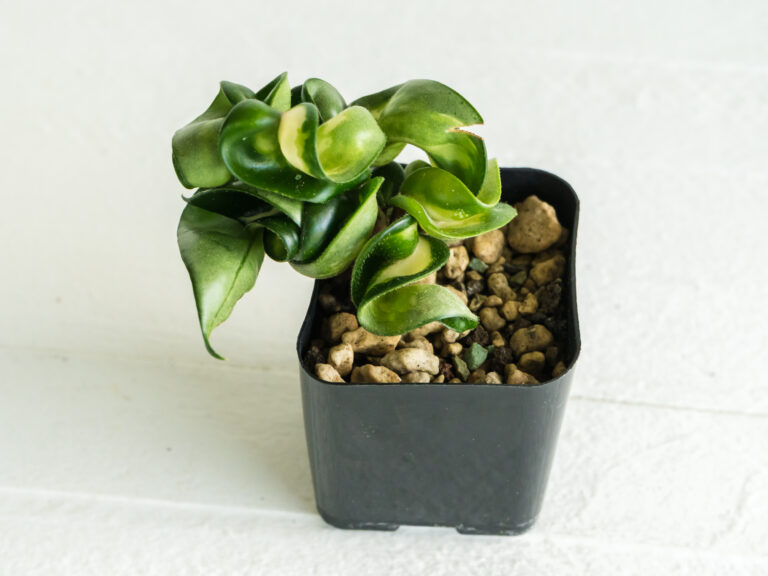 Compacta Mauna Loa (received label)View photo detailsClose photo details
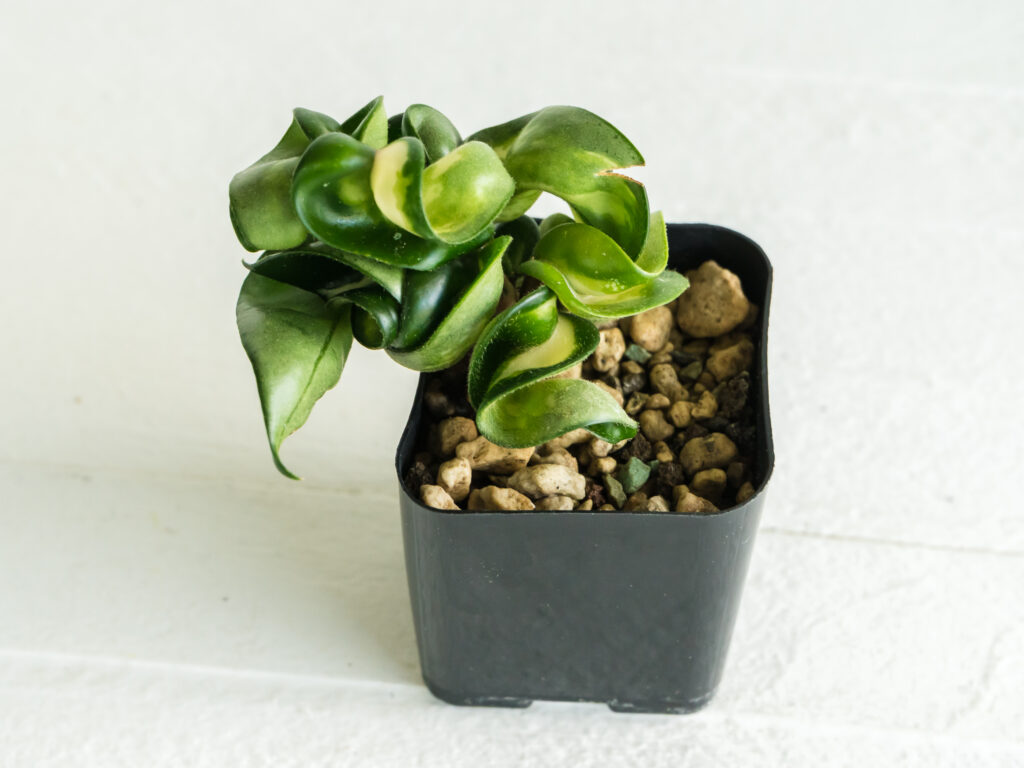
A plant labelled Compacta Mauna Loa, showing tightly folded leaves with green margins and pale cream to light-green central areas. The received label is retained; continuity with the historical patented material is unverified. Public copy has nonessential metadata removed and is resized for display.
Photographer or creator: Rebecca Baron
Identification basis: Received cultivated label and visible foliage only; no botanical voucher or authenticated patent-descendant accession.
Rights and reuse: Displayed with photographer permission; further reuse requires permission.
Image record: IMG-000237
Evidence-Based Growing Insights
No form-specific care conclusion has passed review. The parent Hoya page remains the source for shared information; generic advice is not repeated here.
What We Know
- The reported origin is a sport of cultivated Compacta. The inventor describes propagation through stem cuttings at Winter Garden, Florida (printed col.1 / original PDF p.3).
- The description combines a compact twining woody habit with curled or folded leaves; the upper leaf has a green border and pale centre with light-green blotching (cols.1–3 / PDF pp.3–4).
- Historical leaves are described as usually 35–65 mm long and 20–40 mm wide. Size and folded appearance alone cannot authenticate a modern clone (cols.2–3 / PDF pp.3–4).
- The patent describes umbels of usually 20–40 flowers, with flowers about 14–18 mm across and a moderate pink corolla (cols.3–5 / PDF pp.4–5).
- The 8 May 1973 Certificate of Correction supplies eight corrections and is retained with the original. The name and inventor must be read from the corrected record (original PDF p.6).
- The reported Florida shade and temperature conditions describe the patent’s plants. They do not compare growing methods or establish an optimum for modern collections (printed description / PDF pp.3–5).
- A 1980 trade report pictures a plant captioned Mauna Loa among commercial Hoya selections. The shortened caption records historical trade usage; it does not establish continuity with any present-day plant (printed p.115 / PDF p.1).
What We Are Still Learning
Which living plants have a documented propagation chain to the patented Compacta Mauna Loa?
What would help: Original nursery labels, dated acquisition records and authenticated descendants with a continuous propagation history.
How do pale-centred Compacta labels relate to the historical patented material?
What would help: Original naming and distribution records plus comparisons of traceable plants over maturity; similarity alone is insufficient.
Common Misconceptions
- Mauna Loa belongs with Compacta in this historical record; dropping Compacta obscures the stated parent material.
- A variegated Compacta is not automatically Mauna Loa. Outer-variegated labels such as Regalis or Marginalis require separate histories.
- The patent does not demonstrate that Compacta Mauna Loa needs a distinct care regimen.