Argentea Picta (historical)
Cobia’s 1973 selection, kept separate from the newer plant sold under the same name.
The historical patented selection is kept separate from the newer trade plant. A continuous propagation history has not been established.
Overview
This page concerns the historical Argentea Picta described in Cobia’s 1973 patent. It is separate from the newer plant now sold as Argentea Picta. The historical description combines pale leaf margins, waxy patches or streaks, reddish young growth and frequently irregular flowers. Its survival remains unconfirmed in the evidence examined here, and it may be lost. Modern use of the same name does not demonstrate that the historical cultivar has survived or been rediscovered. The patent sheet below documents the historical plant; the modern trade plant has its own linked page.
Related profiles: Argentea Picta (modern trade plant)
Photo Gallery
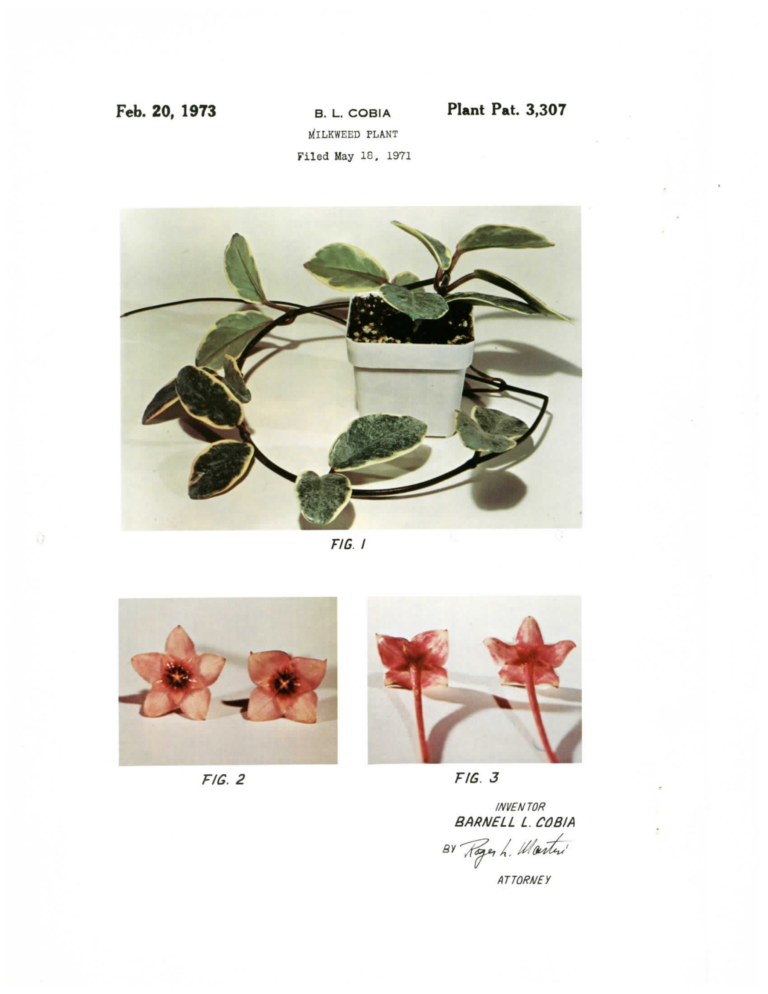 Argentea Picta — historical patent sheetView photo detailsClose photo details
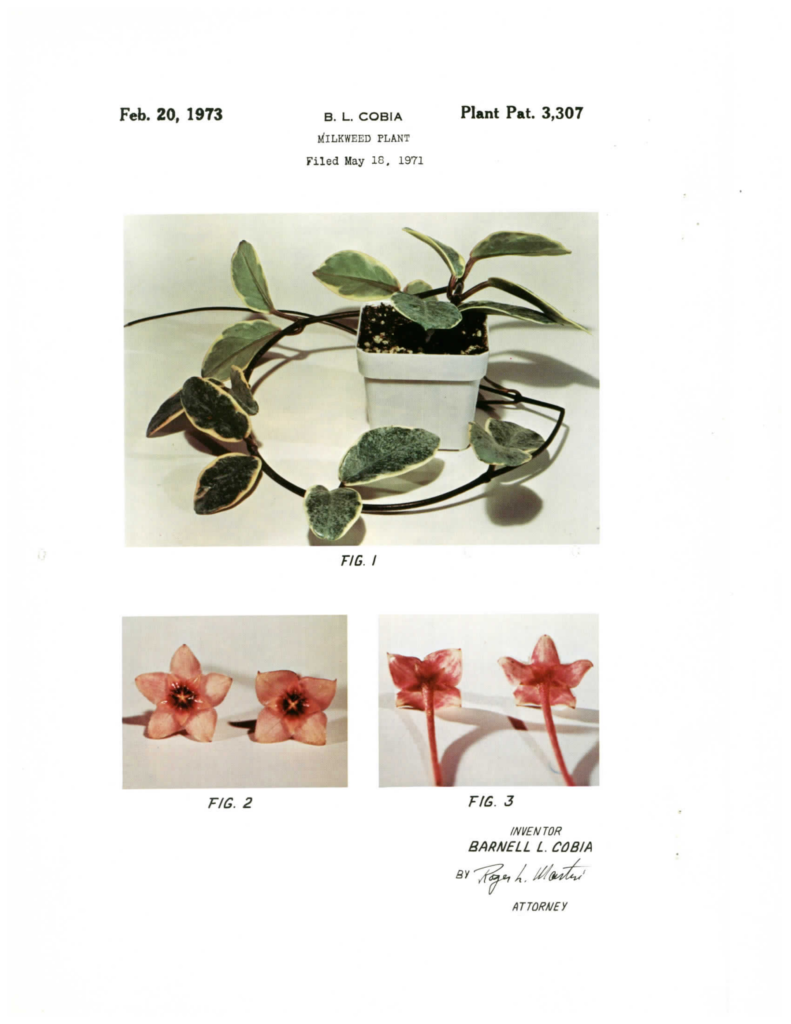
Image source · Rights and reuse terms
Complete photographic sheet from the 1973 Argentea Picta patent. Figure 1 shows the historical plant; Figures 2 and 3 show upper and lower views of two flowers. These are historical source images, not photographs of the newer plant sold under the same name.
Photographer or creator: Barnell L. Cobia, United States Plant Patent 3,307 (1973), Fig.1–3; individual photographer not named
Identification basis: Historical material identified by the patent; this does not identify the modern trade plant or a verified living accession.
Rights and reuse: Complete historical patent-sheet facsimile, preserving source context. No separate open license or reuse grant for the individual photographs is asserted.
Image record: IMG-000030
Evidence-Based Growing Insights
No form-specific care conclusion has passed review. The parent Hoya page remains the source for shared information; generic advice is not repeated here.
What We Know
- The 1973 patent names Barnell L. Cobia as inventor. It was filed on 18 May 1971 and issued on 20 February 1973. The selection is described as a sport on an unnamed plant derived from a sport on Verna Jeanette. That unnamed intermediate must remain part of the reported chain (cols.1–2 / PDF p.2).
- The patent reports repeated propagation by stem cuttings at Winter Garden, Florida, retaining the distinguishing characters. This is the inventor’s historical propagation account; it does not supply a continuous nursery-to-collection history for living plants today (cols.1–2 / PDF p.2).
- The leaves have green centres surrounded by pale borders. Waxy formations partly obscure the upper surface in patches or streaks. Red, purple-red and orange-red tones are described in young leaves and petioles before fading with age. The pattern and colour combination, rather than silver alone, belongs to the historical diagnosis (cols.1–3 / PDF pp.2–3).
- Opposite leaves are usually ovate with an elliptic tendency, with mostly entire margins and rounded or blunt bases. The general description gives mature blades about six months old as usually 30–125 mm long and 15–70 mm wide. Those broad ranges should not be replaced by the smaller measurements of the single example plant (cols.2–3 / PDF pp.2–3).
- The plant is described as a loosely growing twining vine with some branching. During the first six months, stems usually measure 2–6 mm across and internodes 15–80 mm, occasionally reaching 150 mm. These observations describe the historical plants under the stated nursery conditions (col.2 / PDF p.2).
- Umbels contain mainly five-parted flowers with four-parted and occasional three-parted flowers; malformed parts are reported frequently. Flowers usually measure 14–18 mm across. Their upper petal surfaces are densely velvety and pale pink to purplish pink, while the undersides show reddish-purple streaks or patches (cols.4–5 / PDF pp.3–4).
- A separately measured cluster had seventeen flowers: seven undeformed five-parted flowers, six deformed five-parted flowers and four four-parted flowers. That example illustrates the patent’s observations; it is not a fixed flower count or an identification test for every plant (col.6 / PDF p.4).
- The later nursery interview associates SILVER PRINCESS with Argentea Picta and describes the relationship to Verna Jeanette. This is retrospective testimony recorded in 2024 and published in 2025. It complements the patent without identifying a modern accession or independently verifying current trademark status (Green pp.8–9).
- In the later nursery interview, Robert Cobia recalls reddish new-growth colour being transferred by grafting and says the nursery called it the X Factor. The published recollection does not identify a causal agent or supply a controlled experimental dataset. It cannot diagnose the condition of a modern plant (Green p.9).
- The cultivar registrar discusses renewed trade interest but warns that plants circulating under the name may differ. Such a trade history is not a documented chain from the patented plant. The newer trade plant is therefore recorded separately here (registrar, Notes & other sources).
- The nursery description concerns fertilized plants younger than two years under 85 percent shade in Winter Garden, with stated seasonal temperatures. These are observation conditions, not tested indoor care optima. The complete photographic sheet preserves the plant and flower views as published (col.5 / PDF p.4; Fig.1–3 / PDF p.1).
What We Are Still Learning
Does authenticated material of Cobia’s historical Argentea Picta still survive?
What would help: Dated nursery and accession records, an uninterrupted propagation chain, and comparable foliage and flower photographs.
What distinguishes the historical selection from each modern plant sold under the same name?
What would help: Traceable plants compared across leaf ages, flowering and propagation, with their labels and transfer histories retained separately.
What contemporary records document the unnamed intermediate and the later grafting account?
What would help: Original nursery records, the complete 1977 Plants Alive! accounts, experimental records and any identified causal evidence.
Common Misconceptions
- The newer plant sold as Argentea Picta is not treated here as Cobia’s historical cultivar. The shared name does not establish identity.
- Modern sale listings do not prove that the historical cultivar survived or was rediscovered.
- A silver-looking leaf alone does not establish the historical combination of margins, waxy surface, young-growth colour and flower characters.
- The general leaf-size range and measurements of one example plant are different kinds of evidence.
- The X Factor interview is not a confirmed causal diagnosis or a tested care recommendation.