Exotica
An early centre-variegated carnosa cultivar with pale leaf centres and irregular green margins.
Explain Exotica’s 1952 naming and original foliage description, with its distinction from Rubra, Tricolor and unverified modern labels.
Overview
The Hoya cultivar registrar dates establishment of the name Exotica to Shaffer Nurseries’ 1952 catalog. Its original description gives fleshy, predominantly white leaves, irregular edges in two shades of green and slightly ruffled blades. The original selector remains uncertain. Exotica is kept separate from Rubra and Tricolor; a similar leaf pattern or a modern selling label does not establish descent from the historical cultivar.
Photo Gallery
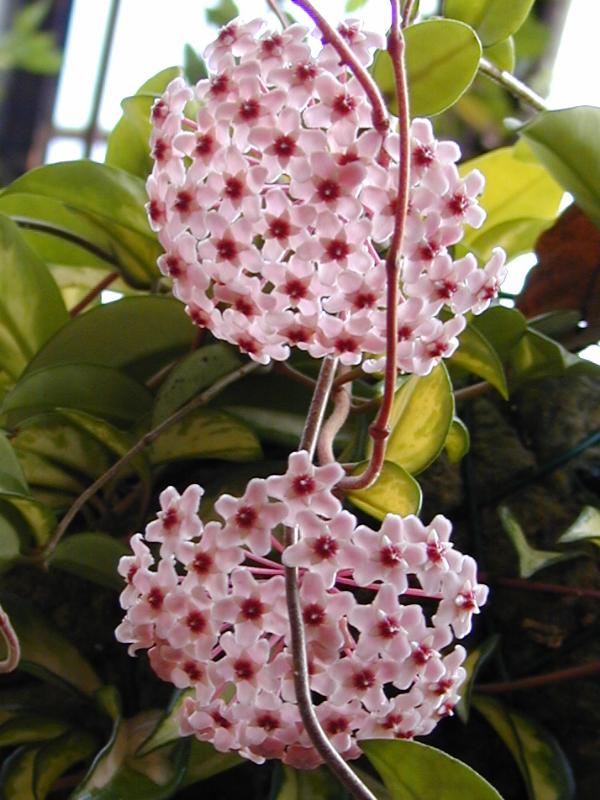 Flowering plant labelled ExoticaView photo detailsClose photo details
Image source · Rights and reuse terms

Pale pink flower clusters and variegated foliage on a plant identified as Exotica by its source. This photograph illustrates the source-labelled plant; continuity with the historical cultivar has not been authenticated.
Photographer or creator: Wayne Boucher
Identification basis: Provider identification on exact Commons file page and visible centre-variegated foliage; historical cultivar lineage unverified.
Rights and reuse: CC BY-SA 2.5. Wayne Boucher; original title Hoya carnosa Exotica1C2000.jpg. Source and license links in Photo details. Metadata checked; no crop, colour edit or enlargement. Source resolution 600 × 800.
Image record: IMG-000246
Evidence-Based Growing Insights
No form-specific care conclusion has passed review. The parent Hoya page remains the source for shared information; generic advice is not repeated here.
What We Know
- The original catalog describes predominantly white, fleshy leaves with irregular green edging in two shades and slightly ruffled blades. Its Variegata entry has the opposite arrangement of dark green centres and pale margins. The illustration on that page is labelled Variegata, rather than Exotica (printed p.18).
- The Hoya cultivar registrar accepts Exotica and attributes establishment of the name to the 1952 catalog. The held scan’s relevant page does not supply a conclusive printed year, so its bibliographic dating remains explicit. The catalog’s first-offering language does not identify the original selector.
- Hummel’s April 1958 price list separately lists carnosa exotica and variegata. This documents historical distribution and name use; it does not show that every later plant bearing either label descends from that nursery’s material (original PDFp.4).
- The Rubra patent compares its new plant with Exotica, describing Rubra as having thicker stems and somewhat broader leaves. It states that Rubra arose on Tricolor. Exotica is the comparison plant in this account, not the stated parent of Rubra (cols.1–2 / PDFp.2).
- The registrar leaves Exotica’s originator uncertain and treats Tricolor as a different cultivar. It does not accept Exotica Tricolor as an established synonym. Similarity between the names or leaf patterns cannot establish that separately labelled plants share a clone.
- The photograph shows flowers and variegated foliage on one plant identified as Exotica by its source. It is an illustration of that labelled plant, rather than proof of continuity with the 1952 material. The reviewed evidence does not establish a separate Exotica-specific care regime.
What We Are Still Learning
Who selected the original Exotica, and how did it reach the early nurseries?
What would help: Dated selector and nursery records, original labels and transfers connecting the earliest catalog material.
Which living plants can be traced to the historical Exotica?
What would help: Accession and propagation records linking living plants to early material, supported by dated foliage and flower photographs.
How do traceable Exotica and Rubra plants differ through growth and propagation?
What would help: Documented accessions compared at similar stages under recorded conditions, with stem, leaf and flower observations.
Common Misconceptions
- The registrar’s 2024 account is not the date Exotica was first established; it points to the 1952 catalog.
- Exotica, Rubra and Tricolor should not be silently merged because they are variegated carnosa cultivars.
- Exotica’s use as a comparison in the Rubra patent does not make it Rubra’s stated parent.
- A modern Exotica or Exotica Tricolor label does not authenticate the historical cultivar.
- Uncertain survival or a report that a cultivar is nearly lost is not evidence that it is extinct.