Rubra
The centre-variegated plant described in the 1972 Rubra patent, with its history kept separate from modern selling labels.
Explain Rubra’s patent description and documented commercial naming history, while identifying the records needed to authenticate modern material.
Overview
Barnell L. Cobia’s patent describes Rubra as a sport found on cultivated Tricolor at Winter Garden, Florida. Exotica is used as a comparison plant, not as the stated parent. The distinguishing description combines young-stem colour and thickness, leaf shape and colour changes, and inflorescence characters. A plant’s present label or pink new growth cannot establish descent from this material. A 1980 trade report pictures Rubra among commercial Hoya selections. A 2025 nursery history associates Rubra with KRIMSON PRINCESS; the historical trademark record documents that commercial designation separately. These records add naming and distribution context, while the propagation history of plants sold today remains unresolved.
Photo Gallery
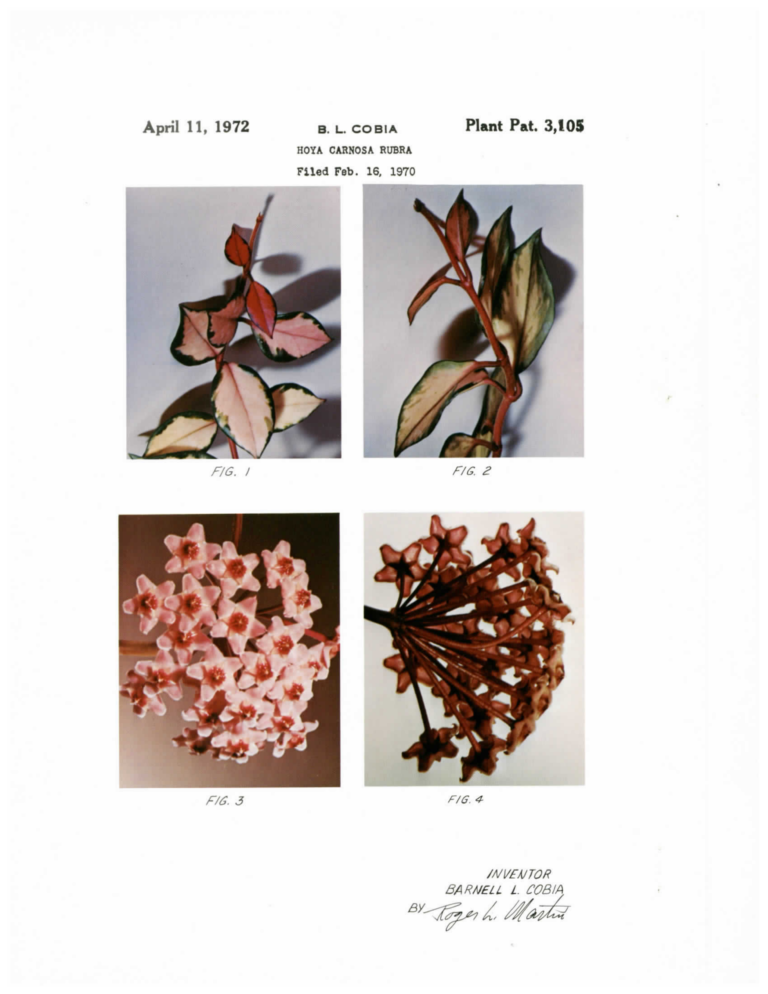 Rubra — 1972 patent photographsView photo detailsClose photo details
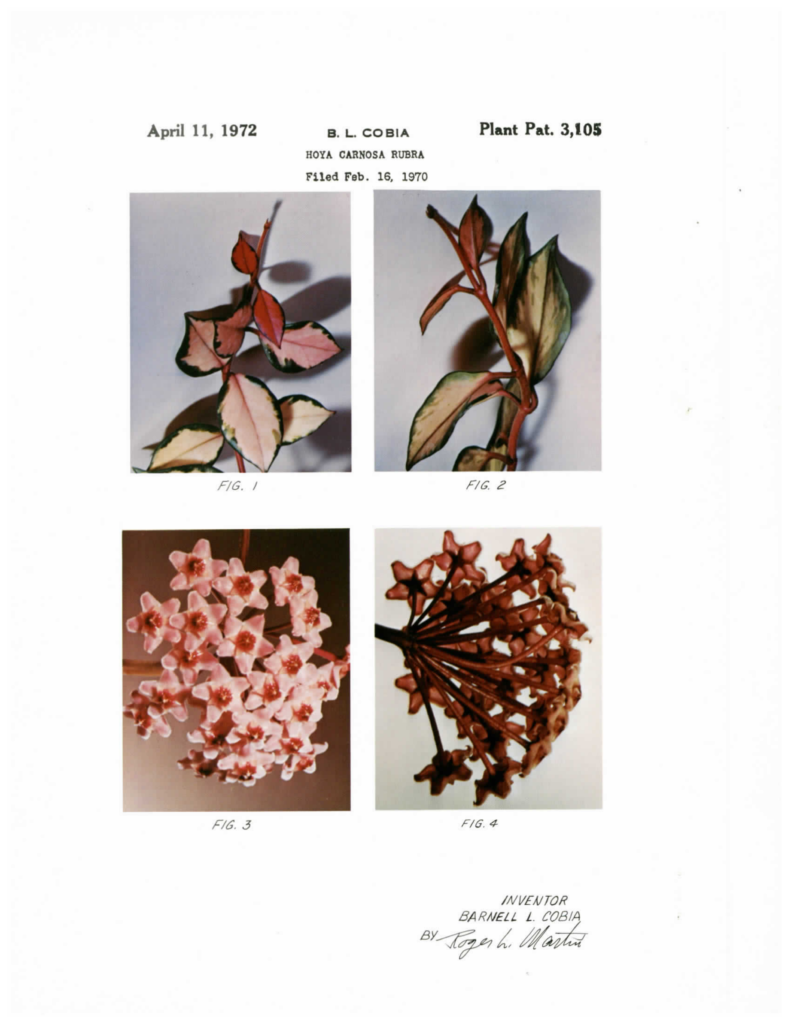
Image source · Rights and reuse terms
Four historical photographs published as the full colour plate of United States Plant Patent 3,105 (1972): upper and lower leaf surfaces and two flower-cluster views. These depict the patent material, not an authenticated present-day accession. Full plate retained; native display resizing only.
Photographer or creator: United States Plant Patent 3,105 (1972), plate p.1; individual photographer uncredited
Identification basis: Patent heading and specification identify the historical material as Rubra; no present-day clone authentication.
Rights and reuse: Faithful patent-plate facsimile under USPTO patent-information guidance. No separate open license asserted for isolated photographs.
Image record: IMG-000006
Evidence-Based Growing Insights
No form-specific care conclusion has passed review. The parent Hoya page remains the source for shared information; generic advice is not repeated here.
What We Know
- The patent reports discovery as a sport on Tricolor and successive asexual propagation by stem cuttings (col.1 / PDF p.2). This is an attributed historical report of the inventor’s material.
- The young leaves are described with a pale centre and green border. Immature centres can show pink, red or purplish hues that fade as leaves mature (cols.3–4 / PDF pp.3–4).
- The described first-year mature leaves are usually ovate, 25–85 mm long and 15–50 mm wide. These are measurements of the historical material, not identification limits for every plant sold today (col.3 / PDF p.3).
- Flowers are described as usually 15–20 mm across, in umbels usually containing 15–45 flowers (cols.4–5 / PDF pp.3–4). The patent does not authenticate photographs of unrelated modern plants.
- The description used fertilized plants under two years old grown under 85% shade in Florida. These are observation conditions, not a controlled demonstration of optimum light or temperature (col.5 / PDF p.4).
- A 1980 trade report includes a photograph captioned Rubra among four commercial Hoya selections. It discusses proposed European naming and registration plans; it does not document completed registrations or prove equivalence among the pictured labels (printed p.115 / PDF p.1).
- A 2025 nursery history associates Rubra with the commercial designation KRIMSON PRINCESS and includes Rubra in its chronology of Cobia introductions. That historical association does not authenticate every plant sold under either label (Stemma 7(1), pp.3–4).
- The 1971 trademark record documents registration 925,734 for KRIMSON PRINCESS on 21 December 1971. A historical trademark registration records commercial naming; it does not establish botanical identity or current legal status (original PDF p.1).
What We Are Still Learning
What records connect plants currently sold as Hoya carnosa Rubra to authenticated descendants of the patented plant?
What would help: Authenticated descendant material or archival nursery and propagation records documenting continuity with the patented clone.
Which distinguishing characters persist in traceable living material?
What would help: Dated leaves, stems and flowers from documented accessions across maturity and successive propagation cycles.
Common Misconceptions
- Rubra’s stated parent Tricolor and its comparator Exotica are different relationships; resemblance does not make either name an accepted synonym.
- Pink new growth and centre variegation alone do not prove that a plant is the patented clone.
- Historical nursery conditions do not establish a separate care requirement for every plant sold as Rubra.