Hoya australis
Hoya australis is a species that grows as a vine or subshrub, with fleshy leaves and clusters of fragrant, cream-to-white flowers with red colouring near the centre. Its name was first published in 1827 in James Traill’s account in the Transactions of the Horticultural Society of London. It is native to parts of Southeast Asia, Australia, New Guinea and the southwestern Pacific.
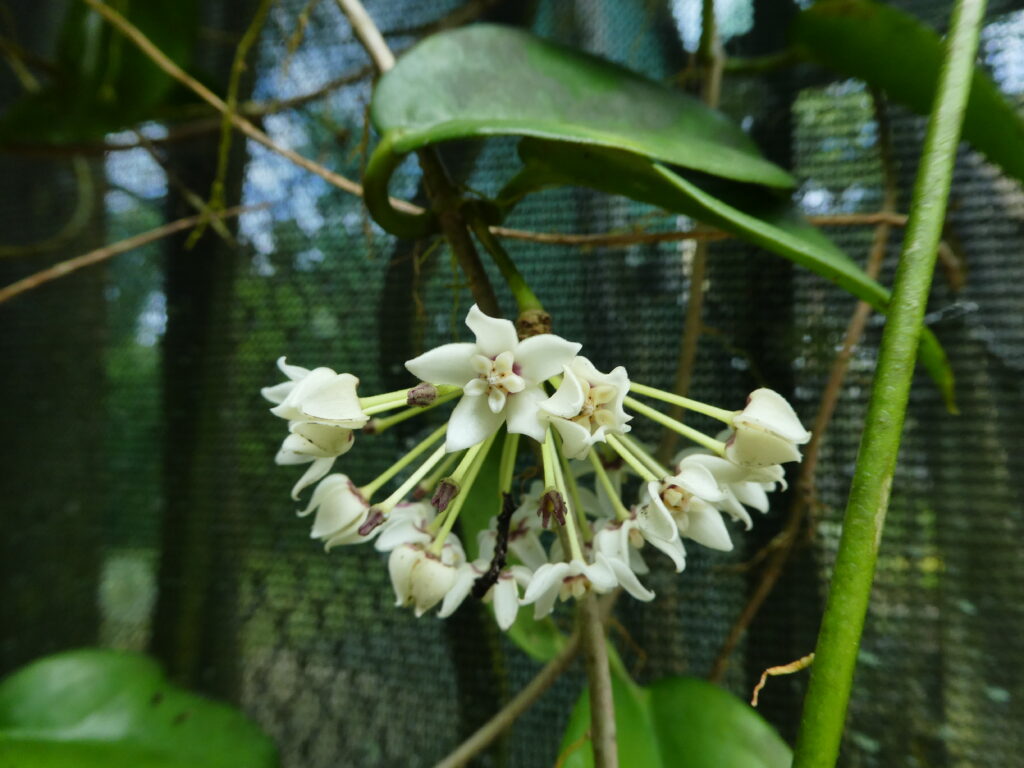
Photo details
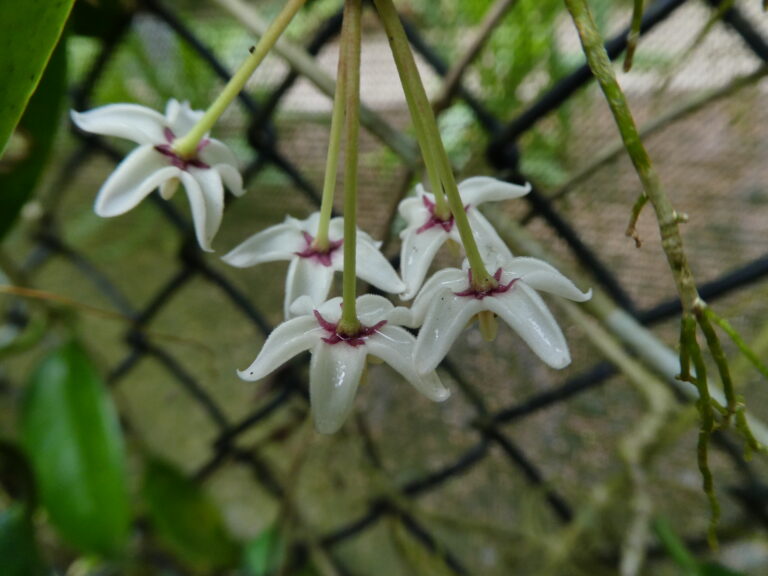
Hoya australis flowers at Cairns Botanic Gardens,Queensland,29July2024. Photo:Steve Fitzgerald,CC BY-SA4.0.
Photo: Steve Fitzgerald (Junglenut)
Reuse: CC BY-SA 4.0
Identification: Source identification; visual consistency checked,not independent specimen/subspecies authentication
Overview
Hoya australis is a species that grows as a vine or subshrub, with fleshy leaves and clusters of fragrant, cream-to-white flowers with red colouring near the centre. Its name was first published in 1827 in James Traill’s account in the Transactions of the Horticultural Society of London. It is native to parts of Southeast Asia, Australia, New Guinea and the southwestern Pacific.
Quick Facts
Pronunciation
HOY-ah aus-TRAH-liss. An English pronunciation guide; capitals mark the stressed syllables. Other pronunciation conventions are also used.
Source and scope
NC State’s English pronunciation, rather than a universal requirement for botanical Latin. Name origin and pronunciation are recorded separately.
Native region
Parts of Southeast Asia, Australia, New Guinea and the southwestern Pacific.
Source and scope
Growth habit
Vine or subshrub.
Source and scope
Leaves
Fleshy; round to elliptical, with smooth or hairy surfaces.
Source and scope
Sap / latex
White latex, described as abundant in the Smithsonian’s Flora of the Hawaiian Islands account.
Source and scope
Species-level flora description. It does not authenticate the sap of each named cultivated selection. Use this character alongside leaves, flowers and provenance.
Flowers
Clusters of cream-to-white flowers with red colouring near the centre.
Source and scope
Fragrance
Very fragrant, according to NC State Extension.
Source and scope
Light
Bright light or dappled sunlight.
Source and scope
Watering
Use a well-drained growing medium and avoid overwatering.
Source and scope
Propagation
Stem cuttings or seed.
Source and scope
What would you add?
Photo Gallery
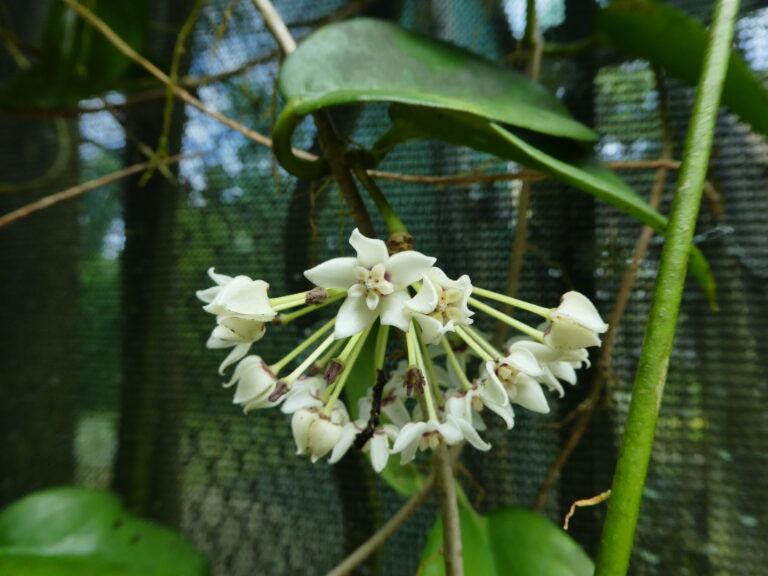 Hoya australisView photo detailsClose photo details
Hoya australis flowers at Cairns Botanic Gardens,Queensland,29July2024. Photo:Steve Fitzgerald,CC BY-SA4.0.
Photo: Steve Fitzgerald (Junglenut)
Reuse: CC BY-SA 4.0
Identification: Source identification; visual consistency checked,not independent specimen/subspecies authentication
Image source · Rights and reuse terms

Image record: IMG-000201
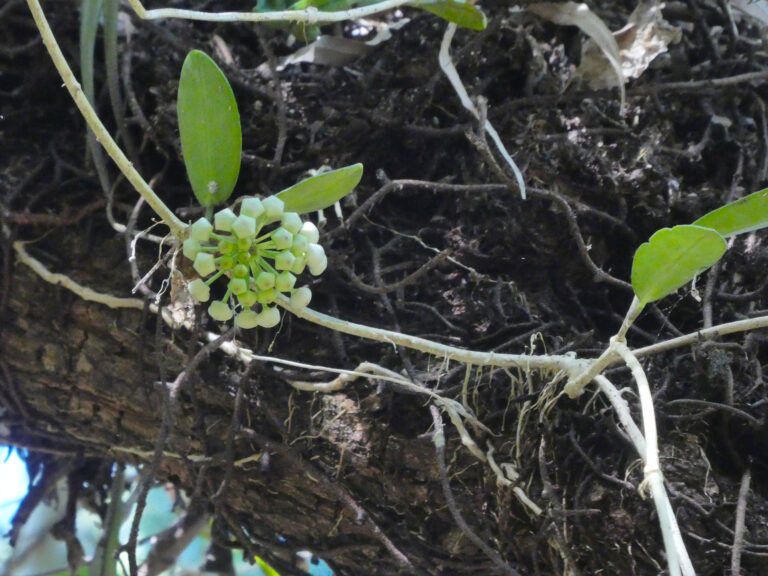 Hoya australisView photo detailsClose photo details
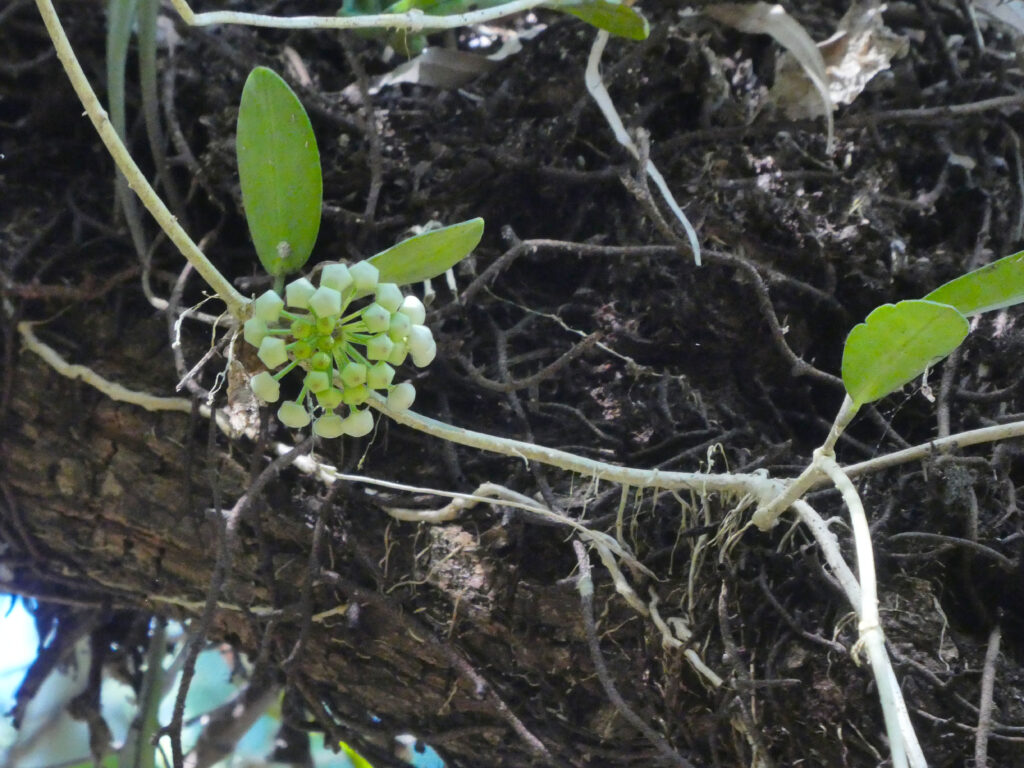
Hoya australis with flower buds in Cairns,Queensland,30June2024. Photo:Steve Fitzgerald,CC BY-SA4.0.
Photo: Steve Fitzgerald (Junglenut)
Reuse: CC BY-SA 4.0
Identification: Source identification; visual consistency checked,not independent specimen/subspecies authentication
Image source · Rights and reuse terms

Image record: IMG-000202
 Hoya australisView photo detailsClose photo details
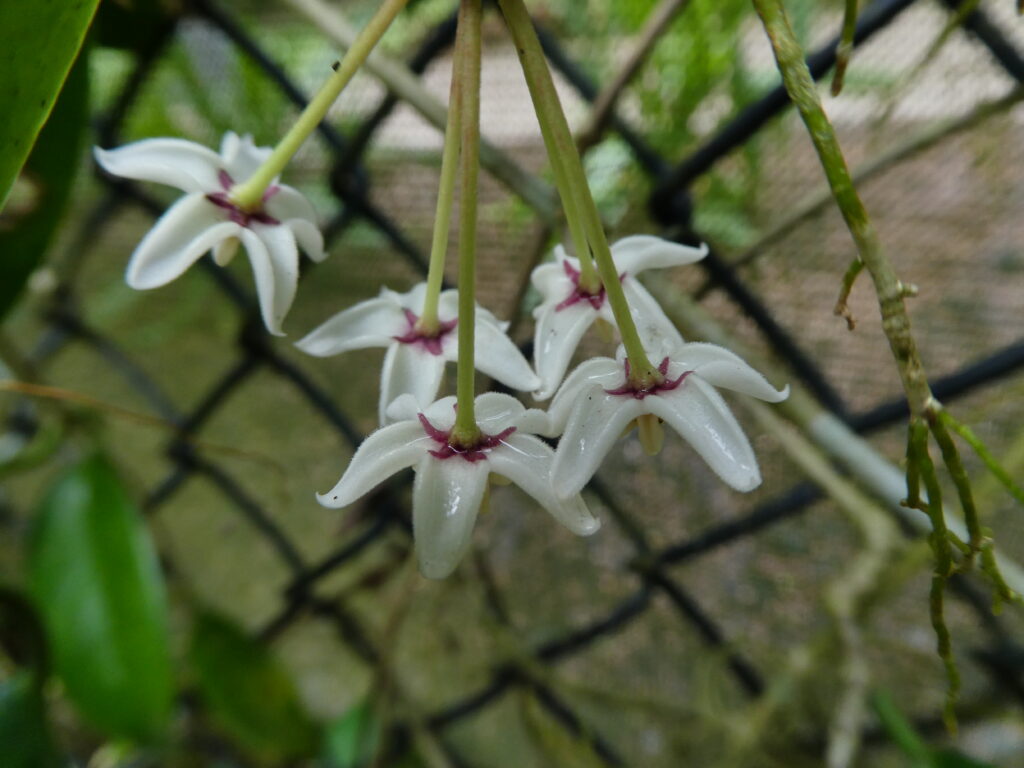
Hoya australis flowers at Cairns Botanic Gardens,Queensland,29July2024. Photo:Steve Fitzgerald,CC BY-SA4.0.
Photo: Steve Fitzgerald (Junglenut)
Reuse: CC BY-SA 4.0
Identification: Source identification; visual consistency checked,not independent specimen/subspecies authentication
Image source · Rights and reuse terms

Image record: IMG-000203
Forms and Growing Profiles
Explore documented cultivated material and other selling labels. A label alone does not establish different care.
Growing Profiles
Hoya australis subsp. australisBotanical subspecies
The typical botanical subspecies and its documented variation.
Sources for this name:
- Forster & Liddle (1996) — Hoya, Flora of Australia 28 — Flora of Australia28(1996), pp.233–234
Hoya australis subsp. melanesicaBotanical subspecies
The accepted botanical name and available records; the missing original account remains a stated gap.
Sources for this name:
- Plants of the World Online — Hoya australis distribution — Accepted subspecies list, checked17October2026;original diagnosis not reviewed
Hoya australis subsp. nathalieaeBotanical subspecies
The accepted botanical name; its missing original account remains a stated gap.
Sources for this name:
- Plants of the World Online — Hoya australis distribution — Accepted subspecies list, checked17October2026;original diagnosis not reviewed
Hoya australis subsp. oramicolaBotanical subspecies
Its climbing growth and documented habitat.
Sources for this name:
- Forster & Liddle (1996) — Hoya, Flora of Australia 28 — Flora of Australia28(1996), p.235
Hoya australis subsp. rupicolaBotanical subspecies
Its succulent foliage and shrubby or scrambling growth on rocky sites.
Sources for this name:
- Forster & Liddle (1996) — Hoya, Flora of Australia 28 — Flora of Australia28(1996), pp.234–235
Hoya australis subsp. sanaBotanical subspecies
Its documented characteristics, retaining historical “sanae” wording in citations.
Sources for this name:
- Forster & Liddle (1996) — Hoya, Flora of Australia 28 — Flora of Australia28(1996), p.235, as sanae
Hoya australis subsp. tenuipesBotanical subspecies
Its documented foliage, flowers and rainforest habitat.
Sources for this name:
- Forster & Liddle (1996) — Hoya, Flora of Australia 28 — Flora of Australia28(1996), p.234
Hoya australis ‘Brookfield’Documented cultivated selection
The cultivated selection documented with bronze new growth and larger flowers.
Hoya australis KapohoDocumented cultivated introduction
The documented Hawaiian introduction, keeping its provenance distinct from other large-leaved plants.
Hoya australis ‘Lisa’Established cultivar
The established variegated cultivar and its naming history.
Hoya australis TongaDocumented cultivated selection
The documented large-leaved selection, without treating “Tonga” as a formal subspecies.
Other names used in cultivation
albomarginataIdentity unresolved
Preserve the source’s wording without assuming it identifies the same material as Blondie or other variegated labels.
AthertonLocality/accession label
A locality/accession record retained under its source-reported identity; the label alone does not verify origin or clone continuity.
Catalogue placement: Hoya australis subsp. tenuipes; IML 0001. This records the source’s identification.
australis silverIdentity unresolved
A selling label with unresolved identity.
Bamboo RangeLocality/accession label
A locality/accession record retained under its source-reported identity; the label alone does not verify origin or clone continuity.
Catalogue placement: Hoya australis subsp. australis; IML 0007. This records the source’s identification.
Blondie / Outer VariegatedIdentity unresolved
Preserve the source’s wording without assuming it identifies the same material as other variegated labels.
Davies CreekLocality/accession label
A locality/accession record retained under its source-reported identity; the label alone does not verify origin or clone continuity.
Catalogue placement: Hoya australis subsp. australis; IML 0005. This records the source’s identification.
GrandeIdentity unresolved
A selling label with unresolved identity.
IML-8Accession reference
An accession reference, without assuming every plant carrying it has verified continuity.
keysii YMDocumented cultivated label
A documented cultivated label; retain its source-reported identity.
MandorahLocality/accession label
A locality/accession record retained under its source-reported identity; the label alone does not verify origin or clone continuity.
Catalogue placement: Hoya australis subsp. oramicola; IML 0123. This records the source’s identification.
Melville IslandLocality/accession label
A locality/accession record retained under its source-reported identity; the label alone does not verify origin or clone continuity.
Catalogue placement: Hoya australis subsp. oramicola; IML 0885. This records the source’s identification.
Mrs. G.Identity unresolved
A historical label with unresolved identity.
P.N.G.Locality/accession label
A locality/accession record retained under its source-reported identity; the label alone does not verify origin or clone continuity.
Catalogue placement: Hoya australis subsp. tenuipes; IML 0564. This records the source’s identification.
Silver ValleyLocality/accession label
A locality/accession record retained under its source-reported identity; the label alone does not verify origin or clone continuity.
Catalogue placement: Hoya australis subsp. australis; IML 0006. This records the source’s identification.
SomersetLocality/accession label
A locality/accession record retained under its source-reported identity; the label alone does not verify origin or clone continuity.
Catalogue placement: Hoya australis subsp. sanae; IML 0171. This records the source’s identification.
variegataIdentity unresolved
Preserve the source’s wording without assuming it identifies the same material as Lisa or other variegated labels.
Research
Where It Grows
Hoya australis is native to parts of Borneo and Sulawesi, New Guinea, northern and eastern Australia, and several island groups across the southwestern Pacific.
Reported native distribution
Regions shown and how to read the map
Native: Borneo; Fiji; New Guinea; New South Wales; Northern Territory; Queensland; Samoa; Solomon Islands; Sulawesi; Tonga; Vanuatu; Wallis and Futuna; Western Australia.
Introduced reports: Cuba; Leeward Islands; Puerto Rico; Society Islands.
Australian shading marks reporting states and territories, not continuous occupancy. Records come from parts of Western Australia, the Northern Territory, Queensland and New South Wales; the New South Wales flora describes a restricted northeastern distribution. Borneo is also a broad reporting unit: the range summary specifies northern Borneo.
The Pacific is displayed continuously across the international date line so Fiji, Tonga, Samoa, and Wallis and Futuna remain together. Small island outlines are retained and emphasized for visibility.
Introduced reports in Cuba, the Leeward Islands, Puerto Rico and the Society Islands are listed separately and are not included in the native shading.
These are simplified TDWG plant-distribution boundaries, not a habitat model or surveyed range edge. Neutral areas are background context; they do not establish absence. Map derived from Kew Backbone Distributions (CC BY 3.0) and TDWG WGSRPD geometry, with simplified outlines and added labels. View the distribution account.
Natural Habitat
Hoya australis grows in several kinds of forest and rocky habitat. The 1991 revision describes different settings for the five subspecies it recognises.
Subsp. australis grows on rock outcrops and cliffs in open eucalypt forest or heath in northern Queensland, and in vine thickets and vine forests farther south and in Melanesia. Subsp. tenuipes grows in rainforest, vine forest and beside mangroves, on trees or rocks.
Subsp. rupicola grows on sandstone outcrops and cliffs in northern Australia. Subsp. oramicola climbs into the canopy of monsoon vine thickets on red laterite on Melville and Bathurst Islands. Subsp. sanae grows in coastal monsoon vine thickets on white sand on Cape York Peninsula and nearby islands.
These accounts describe particular subspecies and places, rather than one habitat shared by every australis plant. They do not establish a single watering schedule, light level or humidity requirement for plants grown at home.
Publication and naming history
James Traill published the name Hoya australis in his account of Hoya in 1827. His account cited material in Robert Brown’s herbarium and credited Brown with the name.
Some references date the account to 1830, the year on the completed bound volume. A review published in 1827 already lists Traill’s paper and Hoya australis. That earlier notice supports using 1827 for the name’s first publication.
Historical names explained
The 1991 revision places names including Hoya dalrympleana, Hoya keysii and Hoya oligotricha under Hoya australis subsp. australis. These are historical botanical treatments, rather than names for three newly established cultivated forms.
A label carrying an older name does not, by itself, establish a plant’s subspecies, accession or propagation history.
The plant, leaves and flowers
Hoya australis ranges from a succulent vine to a subshrub in the 1991 revision. Stems can twine or clamber, becoming somewhat woody with age. The revision also distinguishes the non-twining habit of subsp. rupicola.
Leaves vary from fleshy to leathery and from hairless to hairy. The account includes elliptical, egg-shaped, oblong and nearly round outlines, with leaf blades reaching 15 cm long and 12 cm wide. These are limits in that treatment, rather than expected dimensions for every plant.
The persistent flower clusters can carry up to 50 flowers. The revision describes flowers 10–25 mm across, with white-to-cream petals and red colouring beneath the central cream-coloured crown. Shape, size and leaf differences need to be interpreted alongside the subspecies and source material.
A study of growth, leaves and flowers
In their 1991 study, Paul Forster and David Liddle compared 142 cultivated plant clones of known wild origin. They measured 18 groups of characteristics, including growth habit, leaf thickness and hairiness, and flower structure. Differences in growth habit and leaves separated the plants into five groups.
The study combined fieldwork in Queensland and the Northern Territory with examination of wild-origin plants grown in cultivation. It helps explain why Hoya australis plants can differ in appearance, but it was a study of plant classification rather than a controlled test of indoor growing conditions.
Sources
Quarterly Journal (1827) — contemporary review of Traill’s Hoya account
Unsigned reviewer · 1827 · Locator: Review heading p.159; Hoya notice p.164
Traill (1827) — Hoya account and the australis name
James Traill · 1827 (Part I; completed bound volume dated 1830) · Vol. 7 · Locator: 16–30; Hoya australis p.28
Forster & Liddle (1991) — Variation in Hoya australis
Paul I. Forster; David J. Liddle · 1991 · Vol. 3(3) · Locator: 503–521
Forster & Liddle (1996) — Hoya, Flora of Australia 28
P.I.Forster;D.J.Liddle · 1996 · Locator: 231–237; species description on p.233
Liddle (2009) — nursery catalogue
D. J. and I. M. Liddle / Liddle’s Nursery · 2009-01 · Locator: Catalogue p.3: australis Brookfield IML0256. Catalogue p.8:pubicalyx IML0056 Royal Hawaiin Purple;IML0049,0183,0195,0268,0461 comparison entries. Catalogue p.2: IML identifier policy; p.6: lacunosa IML0045,0377,1648,1813.
Rahayu, Ahmad & Rodda (2022) — Hoya of Sulawesi
Sri Rahayu; Roland P. P. Ahmad; Michele Rodda · 2022 · Vol. 74 · Issue 2 · Locator: 207–221
NC State Extension — Hoya australis
NC State Extension Gardener Plant Toolbox · Undated; accessed 17 October 2026 · Locator: Description;Leaves;Cultural Conditions;Recommended Propagation Strategy
Plants of the World Online — Hoya australis distribution
Royal Botanic Gardens,Kew · Accessed 17 October 2026 · Locator: Accepted status;Distribution;retrieved17October2026
Iowa State Extension — How to Pronounce Scientific Names
Aaron Steil; Iowa State University Extension and Outreach · Undated · Locator: Botanical Latin versus classical Latin; Common Pronunciations
Smithsonian — Hoya australis latex description
Smithsonian Institution, National Museum of Natural History · Undated online account · Locator: Habit
What We Still Do Not Know and Contribute
Which cultivated australis labels refer to the same documented material?
Why it matters: A nursery name alone does not establish an accession’s subspecies or whether plants from two suppliers share the same origin.
How do documented australis accessions respond to different growing conditions?
Why it matters: Published accounts describe several habitats and growth forms. They do not establish a single indoor growing regime or show whether named cultivated selections differ in their needs.