Krinkle 8
The solid-green carnosa cultivar described with broad, dimpled leaves in the 1970 Krinkle 8 patent.
The original green, dimpled cultivar has a documented patent description. A count of dimples or a similar selling name alone cannot establish continuity with that material.
Overview
Krinkle 8 has thick, solid-green leaves with a puckered surface. The 1970 patent describes usually six to ten depressions on each leaf, arranged on either side of the midrib: the name does not require exactly eight. Its leaves remain more open than the tightly folded leaves used for the patent’s comparison with Compacta. The documented plant was a twining vine with pink flowers. Its historical description, reported origin and relationship to later variegated material can be traced through published sources; a modern plant still needs its own propagation history.
Photo Gallery
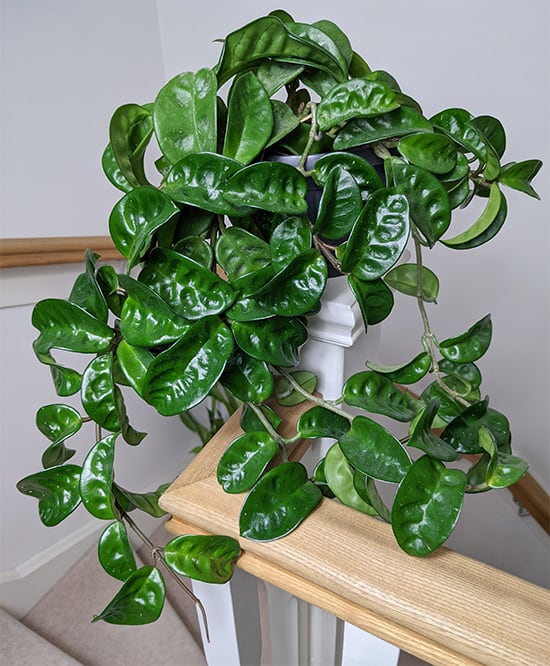 Krinkle 8 — source-identified plant habitView photo detailsClose photo details
Image source · Rights and reuse terms
Trailing stems and dimpled green leaves on a plant identified as Krinkle 8 by OurHouseplants.com. The source identification has not been independently authenticated against the historical cultivar. Uncropped source image; native display resizing only.
Photographer or creator: OurHouseplants.com; individual photographer not separately credited
Identification basis: Source article/photo identifies Krinkle8; original clone continuity unverified.
Rights and reuse: CC BY-NC-SA 4.0. Credit OurHouseplants.com and link to the source and license; noncommercial use only; adaptations retain the same license. Image displayed uncropped; resized for the page.
Image record: IMG-000240
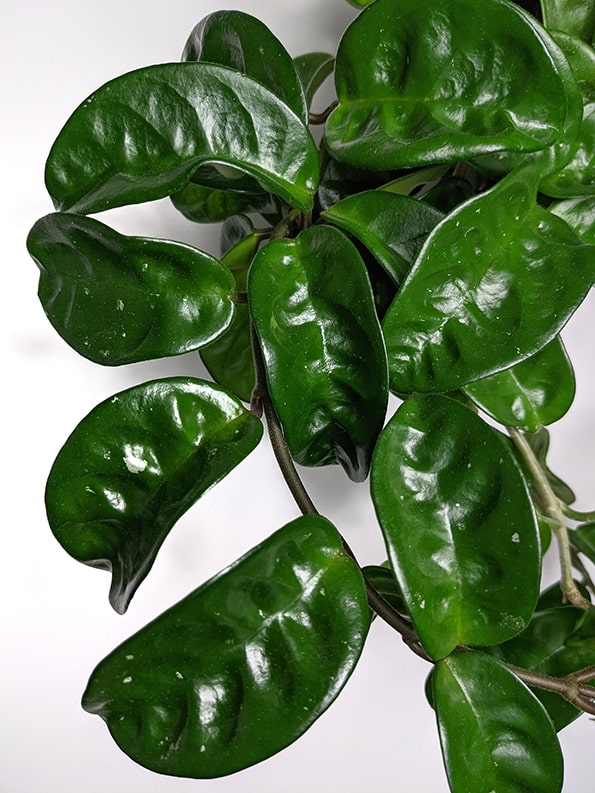 Krinkle 8 — source-identified foliageView photo detailsClose photo details
Image source · Rights and reuse terms
Close-up of thick green leaves with depressions beside the midrib, on a plant identified as Krinkle 8 by OurHouseplants.com. The photograph illustrates the source-labelled plant, not an authenticated propagation chain to the original cultivar. Uncropped source image; native display resizing only.
Photographer or creator: OurHouseplants.com; individual photographer not separately credited
Identification basis: Source article/photo identifies Krinkle8; original clone continuity unverified.
Rights and reuse: CC BY-NC-SA 4.0. Credit OurHouseplants.com and link to the source and license; noncommercial use only; adaptations retain the same license. Image displayed uncropped; resized for the page.
Image record: IMG-000241
Evidence-Based Growing Insights
No form-specific care conclusion has passed review. The parent Hoya page remains the source for shared information; generic advice is not repeated here.
What We Know
- The 1970 patent names Lloyd S. Magnuson as inventor and B.L. Cobia, Inc. as assignee. It reports a mutation on material called Hoya carnosa Exotica, followed by repeated propagation from stem cuttings at Leesburg, Florida. The inventor’s account is evidence for that historical selection; it does not identify unrelated plants sold today (col.1 / PDF p.3).
- The leaves are described as opposite, thick and broadly ovate, with a heart-shaped base and pointed tip. Mature blades usually measure 5–8 cm long and 2.5–4.5 cm wide. Depressions on the upper surface make corresponding raised areas beneath, usually six to ten per blade (cols.2–3 / PDF pp.3–4).
- The plant is described as an evergreen twining vine with some branching. Mature stems usually measure 3–5 mm across, with 20–45 mm between nodes. The patent reports thicker stems and shorter internodes than its Exotica comparison material; these are historical comparisons, not guaranteed dimensions for every growing environment (cols.1–2 / PDF p.3).
- The flowers are described in rounded clusters, usually 20–35 flowers per umbel. Individual flowers usually measure 16–19 mm across, with pink to pale purplish-pink petals that are densely velvety on their upper surface. The waxy corona is described with reddish proximal portions and pale yellow-green distal portions (cols.3–5 / PDF pp.4–5).
- The patent distinguishes Krinkle 8 from Compacta through its more open leaf blades. Its Compacta comparison has strongly folded and recurved leaves that can nearly close. The patent also reports longer, thicker flower stalks and larger flowers in Krinkle 8. This is a comparison of the described material, not a complete identification key for every puckered-leaf carnosa (cols.5–6 / PDF p.5).
- The later interview records Robert Cobia’s recollection that Krinkle 8 was selected from irradiated Hoya material through work with Margaret Gilbert. That interview was conducted in 2024 and published in 2025. The 1970 patent reports a mutation on Exotica and does not describe irradiation. The recollection adds an origin account, but the precise treatment, selection date and chain linking the two accounts still need contemporary documentation (Green p.7; patent col.1).
- The 1978 patent describes Krinkle 8 Variegata as a mutation on Krinkle 8 and explicitly distinguishes the new selection from its parent. The green and variegated names therefore should not be treated as interchangeable descriptions of one plant (cols.1–2 / PDF p.4).
- The AH Hoya catalogue lists Krinkle 8 alongside separately worded small-leaf, large-leaf and red-flowered seed-grown labels. Those entries document commercial usage, not proof that each label is the original cultivar, a distinct registered cultivar or a verified descendant (entries235–238 / PDF p.6).
- The patent reports retention of the distinguishing characteristics through successive stem-cutting propagation. It does not supply a continuous propagation record to present-day collections. Dimple number and leaf shape can help compare a plant with the description, but cannot replace that missing history (cols.1–3 / PDF pp.3–4).
- The patent’s measurements came from fertilized nursery plants in central Florida under 85 percent shade and stated seasonal temperatures. These are observation conditions. They do not establish an optimum indoor light level, watering schedule or cultivar-specific care requirement (col.2 / PDF p.3).
What We Are Still Learning
Which living accessions have a documented propagation chain to the historical Krinkle 8 cultivar?
What would help: Dated nursery labels, purchase or distribution records and a continuous sequence of propagated plants.
How does the later irradiation recollection connect to Magnuson’s original selection?
What would help: Contemporary nursery correspondence, experimental records, treatment dates and records identifying the selected parent and resulting plant.
How consistently do leaf dimensions and dimpling persist in traceable plants under different conditions?
What would help: Repeated measurements across leaf ages and propagated generations, with light, temperature, nutrition and other growing conditions recorded.
Common Misconceptions
- Krinkle 8 does not require exactly eight dimples on every leaf; the original description usually allows six to ten.
- Puckered leaves alone do not establish that a plant is Krinkle 8 or that it is the same clone as Compacta.
- A patent assignee and the named inventor are different roles; the original document names Magnuson as inventor.
- A seed-grown, variegated, splash or size-qualified selling label does not by itself establish continuity with the original green cultivar.
- The later irradiation account is interview testimony, not a published experimental protocol or a modern identity test.