Hoya kerrii
A climbing Hoya with thick, heart-shaped leaves and rounded clusters of waxy flowers.
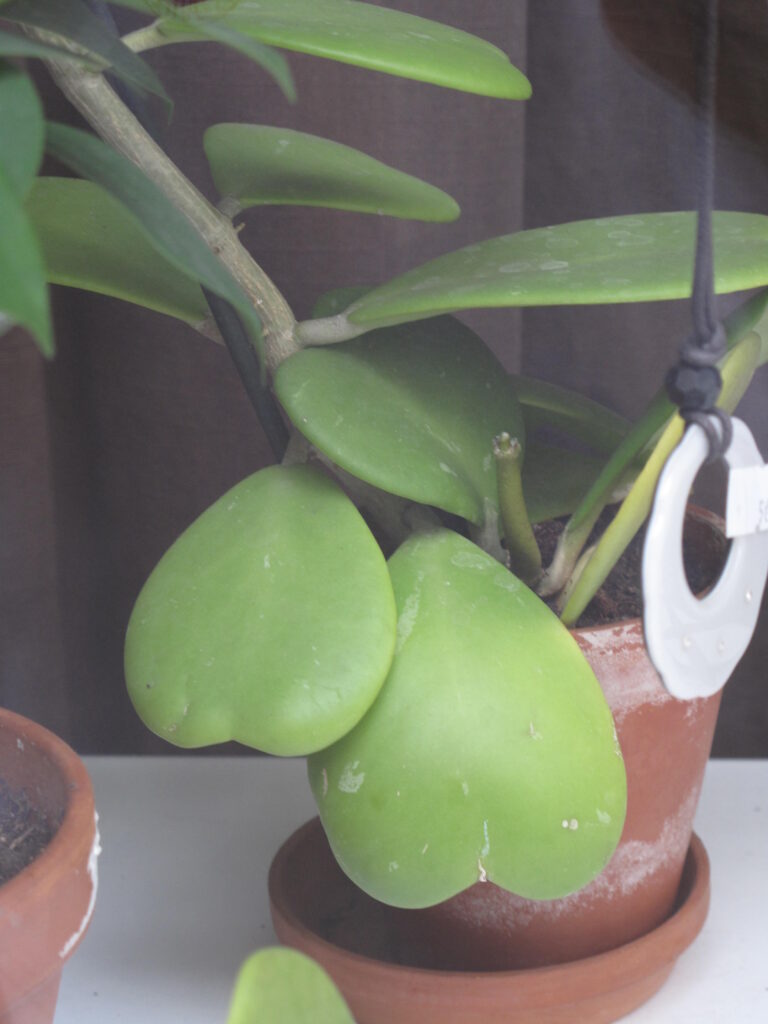
Photo details
Heart-shaped leaves attached to stems on a cultivated plant identified by the photographer as Hoya kerrii. This is a stem illustration, not a documented propagation experiment.
Photo: Tangopaso
Reuse: CC BY-SA 3.0
Identification: Photographer identification plus visual consistency check; cultivated illustration only, no independent voucher/clone authentication.
Overview
Hoya kerrii is a species of climbing Hoya with thick, heart-shaped leaves and rounded clusters of creamy-white, star-shaped flowers with reddish to purple centres. William Grant Craib first published its name in 1911. Its native range extends from Indochina to western Malesia, including Cambodia, Laos, Thailand, Vietnam, Malaya and Java.
Quick Facts
Taxonomic status
Hoya kerrii Craib is an accepted species.
Source and scope
Name first published
William Grant Craib first described the species in 1911, in Kew Bulletin, pages 418–419.
Source and scope
Common names
Sweetheart Hoya, Valentine Hoya, Wax Hearts, 心叶球兰, Lucky Heart Plant, Sweetheart Plant and Sweetheart Valentine Hoya.
Source and scope
Common names vary by region and can be shared by different plants. NC State lists the English names; NParks uses 心叶球兰 in its Albomarginata account. These names do not establish a cultivar or botanical identity.
Name meaning
Kerrii honours Arthur Francis George Kerr, the physician and plant collector who worked in Thailand and Southeast Asia.
Source and scope
Pronunciation
HOY-ah KAIR-ee-eye. An English pronunciation guide; capitals mark the stressed syllables. Other pronunciation conventions are also used.
Source and scope
NC State’s English pronunciation, rather than a universal requirement for botanical Latin. Name origin and pronunciation are recorded separately.
Native region
Kew lists Cambodia, Jawa, Laos, Malaya, Thailand and Vietnam as native, and southeastern China as introduced.
Source and scope
Natural habitat
Recorded as an epiphyte or lithophyte, primarily in the wet tropical biome.
Source and scope
Growth habit
Climbing vine.
Source and scope
Leaves
Thick, leathery, opposite leaves with a notched tip that gives them their heart shape; the botanical garden account reports blades 4–12 cm long and 5–9 cm wide.
Source and scope
Sap / latex
White latex is reported in the botanical description. This is the sap in plant tissues, distinct from the coloured nectar produced by the flowers.
Source and scope
Flowers
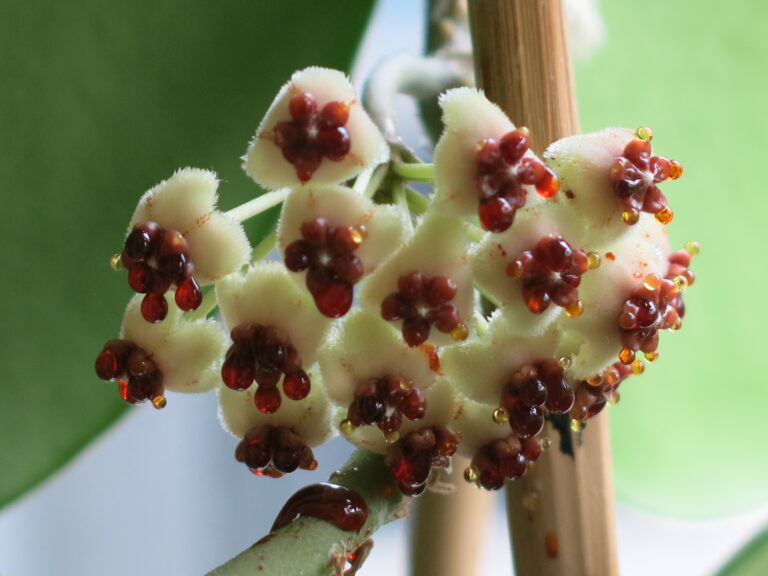
Rounded clusters of creamy-white flowers with purple colouring; the botanical garden account reports 10–15 flowers in a cluster.
Source and scope
Fragrance
NC State Extension reports fragrance at night.
Source and scope
What would you add?
Photo Gallery
Hoya kerriiView photo detailsClose photo details
Heart-shaped leaves attached to stems on a cultivated plant identified by the photographer as Hoya kerrii. This is a stem illustration, not a documented propagation experiment.
Photo: Tangopaso
Reuse: CC BY-SA 3.0
Identification: Photographer identification plus visual consistency check; cultivated illustration only, no independent voucher/clone authentication.
Image source · Rights and reuse terms

Image record: WP-MEDIA-1024
 Hoya kerriiView photo detailsClose photo details
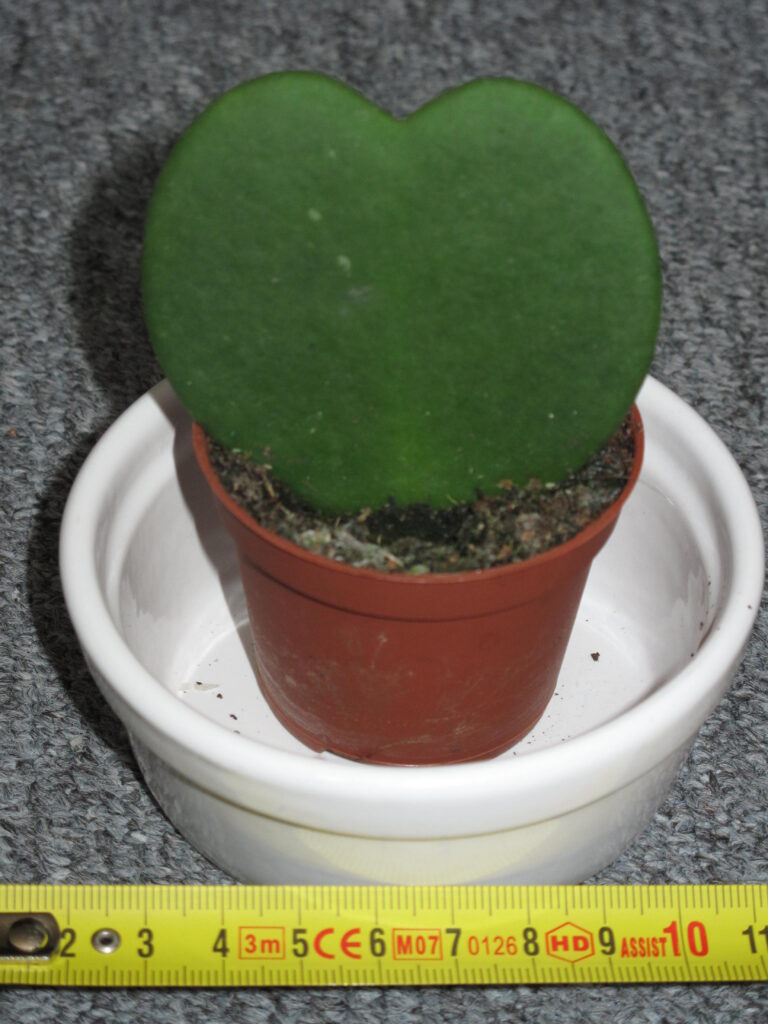
A single potted leaf identified by the photographer as Hoya kerrii. The photograph does not show the anatomy below the potting mix or establish whether stem tissue is present.
Photo: Tangopaso
Reuse: CC BY-SA 3.0
Identification: Photographer identification plus visual consistency check; cultivated illustration only, no independent voucher/clone authentication.
Image source · Rights and reuse terms

Image record: WP-MEDIA-1025
 Hoya kerriiView photo detailsClose photo details
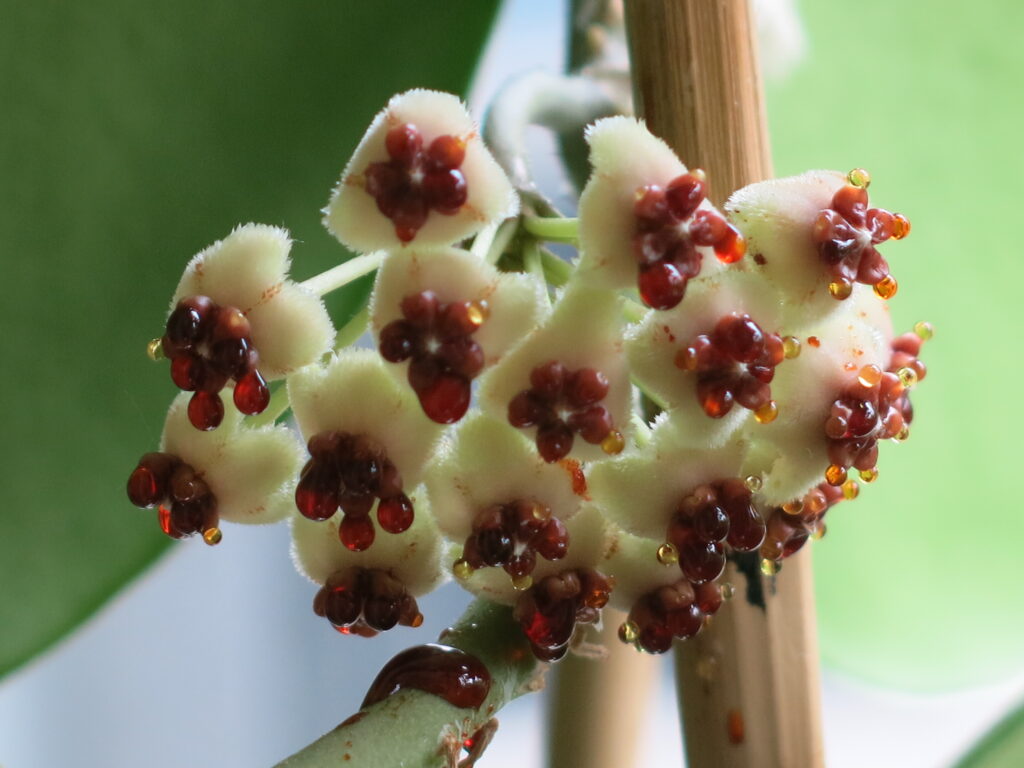
Flower cluster on a cultivated plant identified by the photographer as Hoya kerrii. No cultivar or wild provenance is established.
Photo: Tangopaso
Reuse: CC BY-SA 3.0
Identification: Photographer identification plus visual consistency check; cultivated illustration only, no independent voucher/clone authentication.
Image source · Rights and reuse terms

Image record: WP-MEDIA-1026
Forms and Growing Profiles
Cultivated relationships
Kerrii is grown with green leaves, variegated leaves, splash and other named differences. The documented labels below are not all established cultivars or distinct clones. Growing Profiles are being added as their source and material records are checked.
Explore documented cultivated material and other selling labels. A label alone does not establish different care.
Growing Profiles
Hoya kerrii — Albomarginata / outer variegatedDescriptive variegation label
Green, heart-shaped leaves with irregular cream edges, as described by NParks.
Sources for this name:
- NParks — Hoya kerrii Albomarginata — Foliage; Biogeography
Hoya kerrii — Pubescent-leaved — IML 0784Historical nursery accession; present stock continuity unresolved
Liddle’s 2009 catalogue records a pubescent-leaved kerrii from Thailand as IML 0784; later grower reports retain that accession label.
Sources for this name:
- Vermont Hoyas — IML 0784 sun-exposure account (2017) — Article body paragraphs1–3; dated footer
- Vermont Hoyas — IML 0784 flowering account (2017) — Article body paragraph1; dated footer
Hoya kerrii — Speckles (accession unresolved)Collection label; accession number unresolved
The conflicting IML 1780 captions behind the kerrii Speckles label.
Sources for this name:
- MyHoyas — kerrii cultivated labels — Album K, Hoya kerrii Speckles IML 1780 caption
- MyHoyas — album N accession labels — Album N, Hoya nabawanensis IML 1780 caption
Hoya kerrii — Yellow-centred variegated — IML 1497Historical nursery accession; present stock continuity unresolved
The yellow-centred, green-edged kerrii documented as IML 1497 in Liddle’s 2009 catalogue.
Other names used in cultivation
VariegataUnspecified variegation label
AH Hoya and MyHoyas record this label; its equivalence with other variegated material is unresolved.
Sources for this name:
- MyHoyas — kerrii cultivated labels — K album, Hoya kerrii labels and Speckles IML1780
Evidence-Based Growing Insights
These notes report what a source or observation says, show what can reasonably be inferred, and keep the limits visible. They are not universal care promises.
No scientifically supported growing insight is ready for this Hoya. Published field observations or controlled cultivation studies of identified plants are needed before a practical recommendation can be drawn.
What would you add?
Research
Where It Grows
Hoya kerrii is native to Cambodia, Java, Laos, Peninsular Malaysia, Thailand and Vietnam. It is also reported as introduced in southeastern China.
Reported distribution
Regions shown and how to read the map
Native: Cambodia; Java; Laos; Peninsular Malaysia; Thailand; Vietnam.
Introduced reports: Southeastern China.
Southeastern China is shown in amber as an introduced reporting region, separate from the native range. Flora of China records cultivated plants in southern Guangdong; those cultivated reports do not establish a native Chinese range.
Java and Peninsular Malaysia are the familiar names used here for the source’s Jawa and Malaya. Older regional accounts can list fewer places than the current global distribution account.
These are simplified TDWG plant-distribution boundaries, not a habitat model or surveyed range edge. Neutral areas are background context; they do not establish absence. Map derived from Kew Backbone Distributions (CC BY 3.0) and TDWG WGSRPD geometry, with simplified outlines and added labels. View the distribution account.
Natural Habitat
Plants of the World Online describes Hoya kerrii as a climbing epiphyte or lithophyte in the wet tropical biome. It can grow on other plants or on rock. This broad description is not a measurement of the conditions around every wild plant, and it does not give an indoor watering schedule.
Publication and naming history
William Grant Craib published Hoya kerrii in 1911, in Kew Bulletin on pages 418–419. The name honours Arthur Francis George Kerr, whose plant collecting in Thailand is described by NC State Extension.
Historical names explained
Plants of the World Online accepts Hoya kerrii as a species. It lists Hoya obovata var. kerrii (Craib) Costantin, published in 1912, as a synonym. An older label using that combination does not describe a separate cultivated form.
The plant, leaves and flowers
Hoya kerrii is a climbing plant with thick, broad leaves. The notch at the tip gives the leaves their familiar heart-shaped outline.
Suan Luang Rama IX Foundation (2023) describes clusters of creamy-white flowers with purple colouring. NC State Extension — Hoya kerrii describes reddish-brown nectar dripping from the flowers. Nectar is a flower secretion, distinct from the white latex described in the plant’s tissues.
These descriptions concern the species accounts. They do not authenticate a named cultivated selection, and a heart-shaped leaf alone does not establish a plant’s identity.
Single-leaf pots: will a heart leaf grow into a vine?
Hoya kerrii is sold as rooted stem cuttings and growing plants, as well as the small pots containing just one heart-shaped leaf that appear around Valentine’s Day. It is those single-leaf pots that raise the question: will the leaf eventually produce a stem and more leaves?
Iowa State Extension — All About Hoyas explains that a detached leaf can root without becoming a vine if no stem node was included. NC State Extension — Hoya kerrii gives a qualified account: single rooted leaves are unlikely to grow well unless some stem tissue was attached when they were cut. A stem node is the point where a leaf joins the stem; it is different from the leaf stalk.
If you want a climbing plant, Iowa State recommends buying a stem cutting with at least one node or a plant with a growing stem. A healthy-looking leaf and roots alone do not show whether a node is present beneath the potting mix.
Sap, flowers and identification
The colour of flower droplets should not be recorded as the colour of the plant’s sap. The botanical description distinguishes white latex from the reddish-brown nectar described in the flowers.
Record sap alongside leaves, flowers and provenance. White latex alone does not identify a plant as kerrii.
Is Chiang Dao Silver related to kerrii?
The name Hoya sp. Chiang Dao (Silver) is used by Hoya Cuttings. Unsolicited Plant Talks suggests that Chiang Dao material could be a natural hybrid involving Hoya kerrii. That is a nursery hypothesis, not verified parentage. Its account also does not establish that its plants and every plant sold as Chiang Dao Silver are the same material.
The resemblance raises a useful identification question, but silver colour and a heart-shaped leaf do not settle it. The relationship remains unresolved in these accounts. Keep the Chiang Dao Silver label with the plant’s supplier and provenance rather than relabelling it as a form or hybrid of kerrii. Authenticated flowering material and a published comparison would help resolve the question.
Hoya kerrii and Hoya carrii are different species
Hoya carrii is a separate accepted species in Kew’s Plants of the World Online, first published in 2017 and native to Papua New Guinea. Hoya kerrii was published in 1911 and has a native range from Indochina to western Malesia. The similar spellings do not make carrii an alternative spelling or a cultivated form of kerrii.
Check the complete name on labels and references. A name comparison distinguishes the two species; it does not identify an unlabelled plant from its foliage alone.
Sources
Craib (1911) — Hoya kerrii
William Grant Craib · 1911 · Locator: Kew Bulletin 1911:418–419; original scan PDF438–439. Existing project extraction K01 and bibliographic witness.
Suan Luang Rama IX Foundation (2023) — Hoya kerrii
Suan Luang Rama IX Foundation · 2023 · Locator: Plants in Suan Luang Rama IX, volume 4; printed page 36 / PDF page 40; English description. Foundation title page PDF5.
Iowa State Extension — All About Hoyas
Aaron Steil; Iowa State University Extension and Outreach · Last reviewed February 2026; accessed 20 October 2026 · Locator: Sweetheart Hoya; Propagation
NC State Extension — Hoya kerrii
NC State Extension Gardener Plant Toolbox · Accessed 20 October 2026; publication date not established · Locator: Description; Whole Plant Traits; Flowers; Leaves
Plants of the World Online — Hoya kerrii
Royal Botanic Gardens, Kew · Accessed 20 October 2026 · Locator: Accepted status; Distribution; Synonyms; first publication
Iowa State Extension — How to Pronounce Scientific Names
Aaron Steil; Iowa State University Extension and Outreach · Undated · Locator: Botanical Latin versus classical Latin; Common Pronunciations
What We Still Do Not Know and Contribute
Which kerrii labels identify the same cultivated material?
Why it matters: Similar labels can describe different plants, while one plant may circulate under more than one name.
When does a single rooted kerrii leaf produce a new shoot?
Why it matters: A rooted leaf and a node-bearing stem cutting are different starting material. The tissue included below the soil is often unknown.