Krinkle 8 Variegata
The historical outer-variegated, dimpled cultivar described in 1978; the registrar reports it lost or nearly lost.
A separately patented marginally variegated selection from Krinkle 8; leaf pattern and dimpling alone do not authenticate a modern accession.
Overview
Krinkle 8 Variegata is the historical outer-variegated selection described in the 1978 patent. Its puckered leaves have pale, uneven margins around green centres; the margins can be interrupted. The cultivar registrar describes it as lost or nearly lost and separates it from the inner-variegated plant sold under the same name. Survival of traceable historical material remains unresolved. The patent photographs below document that historical selection; they do not establish its continued availability. Young pale margins may carry pink or orange-yellow tones, and the patent describes a twining habit with pink flowers.
Related profiles: Krinkle 8
Photo Gallery
 Krinkle 8 Variegata — historical patent Sheet 1View photo detailsClose photo details
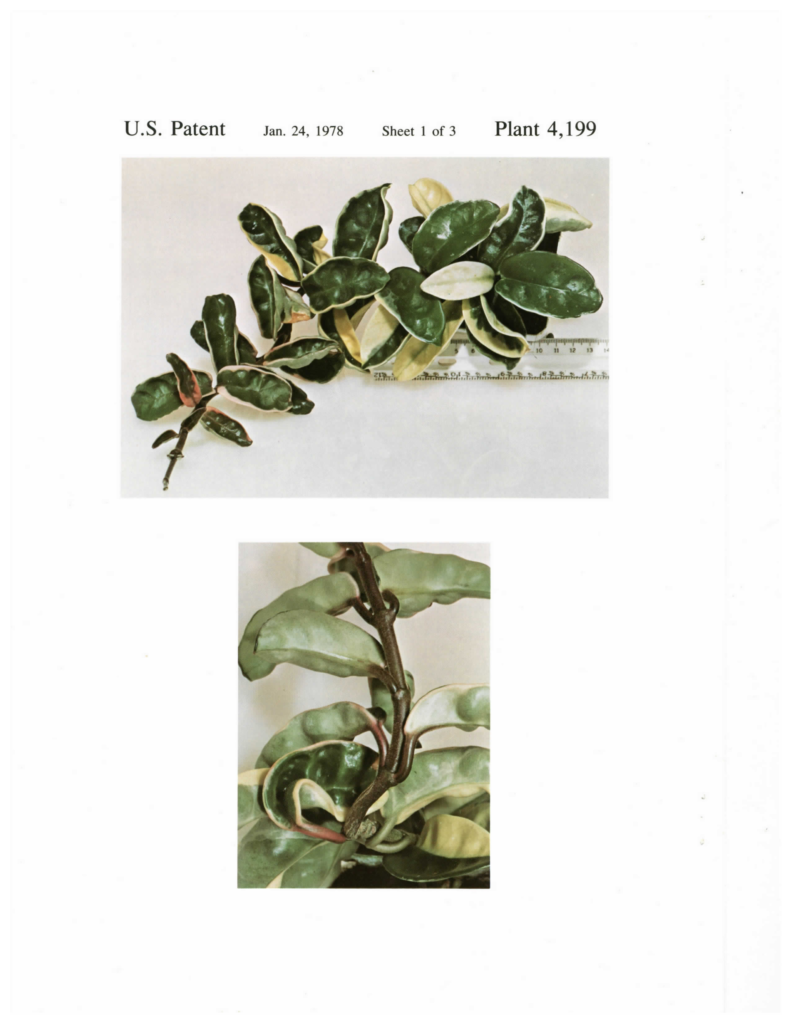
Image source · Rights and reuse terms
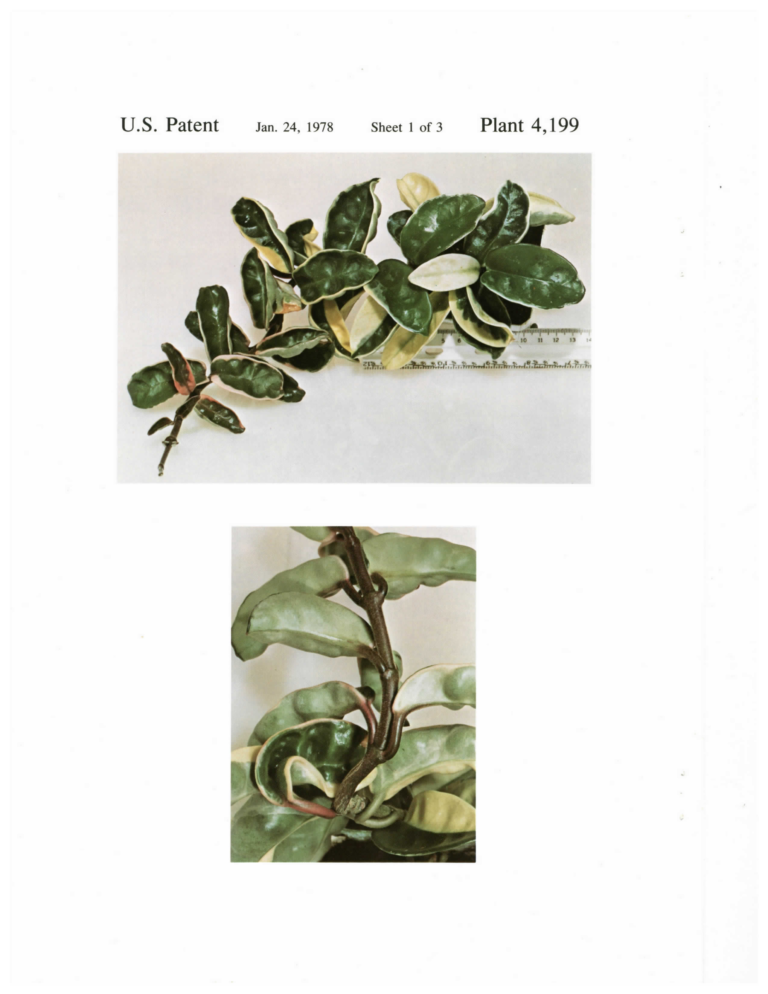
Complete Sheet 1 from the 1978 Krinkle 8 Variegata patent: a laid-out vine with ruler above, and variegated foliage with stem detail below. The illustrated material is identified by the patent; no modern accession is authenticated.
Photographer or creator: Cobia & Griffith, United States Plant Patent 4,199 (1978), Sheet 1; individual photographer not named
Identification basis: Historical material identified by the patent; not a modern authenticated accession.
Rights and reuse: Complete patent-sheet facsimile for historical research, preserving its source context. No separate open license or permission for reuse of the individual photographs is asserted. Source: United States Plant Patent 4,199 (1978); photographer not named.
Image record: IMG-000035
 Krinkle 8 Variegata — historical patent Sheet 2View photo detailsClose photo details
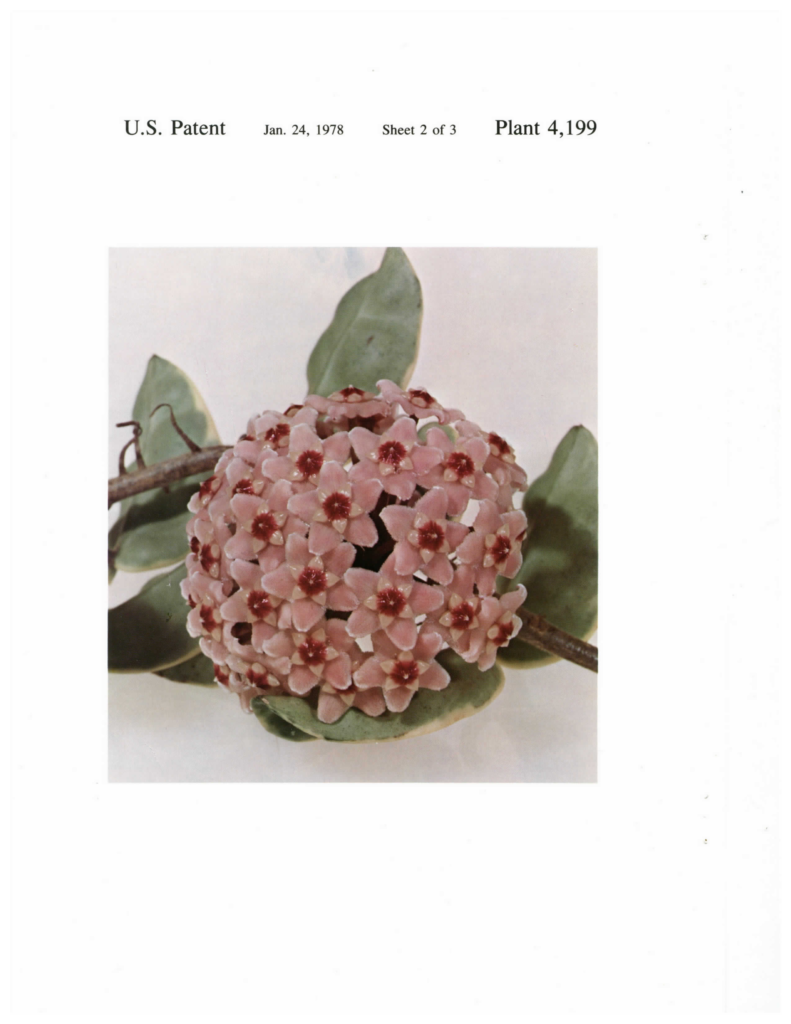
Image source · Rights and reuse terms
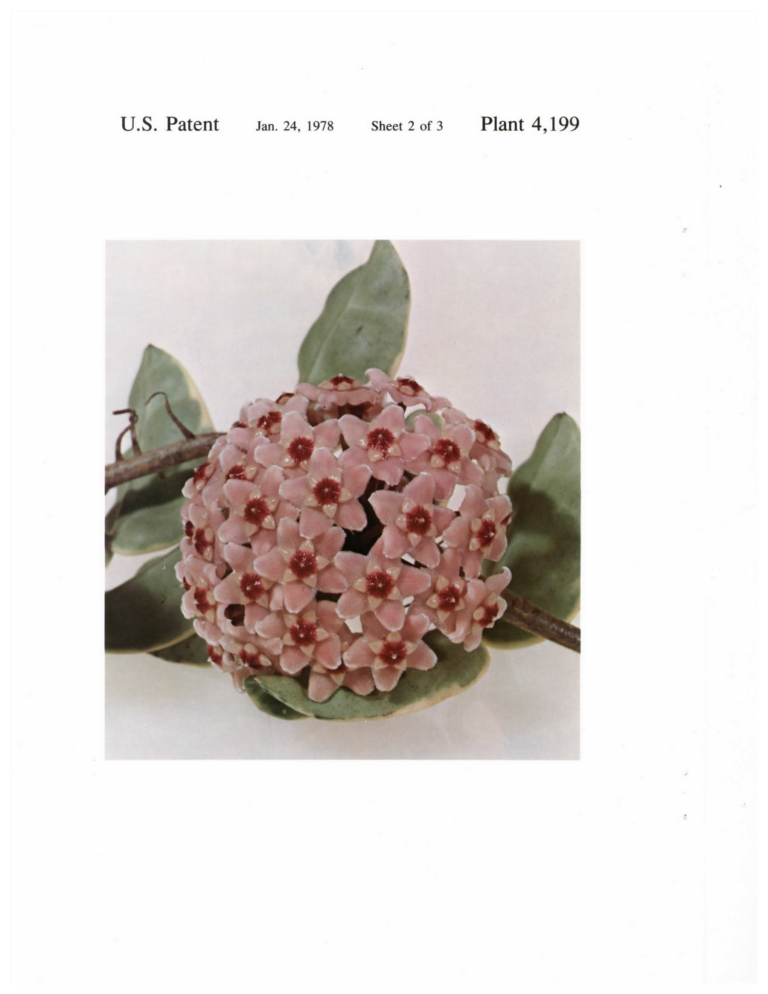
Complete Sheet 2 from the 1978 Krinkle 8 Variegata patent, showing an open pink-flowered cluster on the source-described plant.
Photographer or creator: Cobia & Griffith, United States Plant Patent 4,199 (1978), Sheet 2; individual photographer not named
Identification basis: Historical material identified by the patent; not a modern authenticated accession.
Rights and reuse: Complete patent-sheet facsimile for historical research, preserving its source context. No separate open license or permission for reuse of the individual photographs is asserted. Source: United States Plant Patent 4,199 (1978); photographer not named.
Image record: IMG-000036
 Krinkle 8 Variegata — historical patent Sheet 3View photo detailsClose photo details
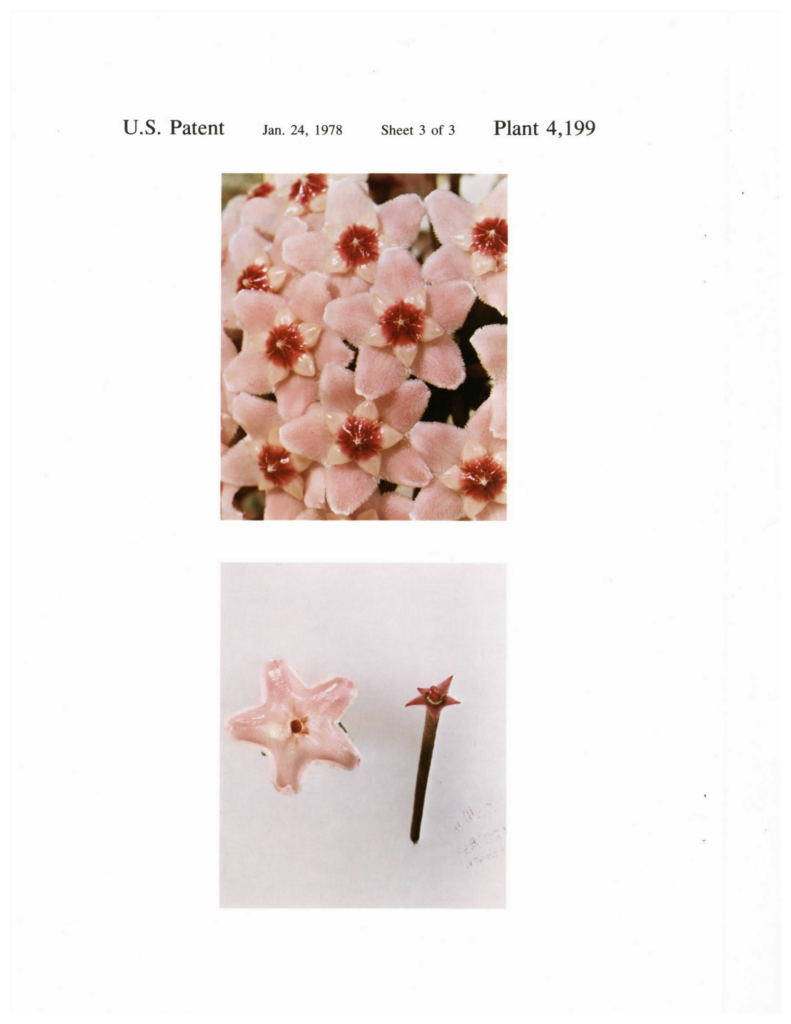
Image source · Rights and reuse terms
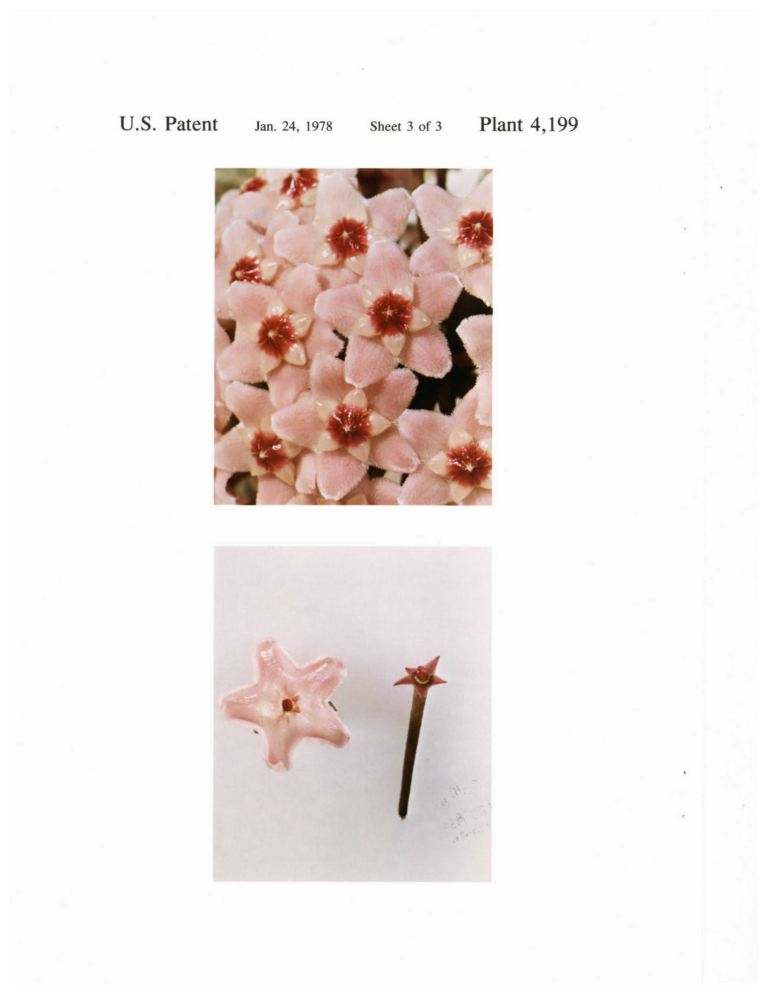
Complete Sheet 3 from the 1978 Krinkle 8 Variegata patent: enlarged flowers above, with a detached flower underside and remaining floral structure below.
Photographer or creator: Cobia & Griffith, United States Plant Patent 4,199 (1978), Sheet 3; individual photographer not named
Identification basis: Historical material identified by the patent; not a modern authenticated accession.
Rights and reuse: Complete patent-sheet facsimile for historical research, preserving its source context. No separate open license or permission for reuse of the individual photographs is asserted. Source: United States Plant Patent 4,199 (1978); photographer not named.
Image record: IMG-000037
Evidence-Based Growing Insights
No form-specific care conclusion has passed review. The parent Hoya page remains the source for shared information; generic advice is not repeated here.
What We Know
- The cultivar registrar reports the historical cultivar as lost or nearly lost, and distinguishes it from an unnamed inner-variegated plant sold under the established name. This is an attributed availability assessment, not proof that no living plant survives. Pale leaf centres surrounded by green do not match the patent’s principal marginal-variegation diagnosis (registrar, Description and Availability; patent cols.1 and8).
- The 1978 patent names Barnell L. Cobia and Stephen H. Griffith as inventors and B.L. Cobia, Inc. as assignee. Filed on 18 January 1977 and issued on 24 January 1978, it reports a mutation on Krinkle 8 and repeated propagation by stem cuttings at Winter Garden, Florida (title block and col.1 / PDF p.4).
- The principal distinction from the green parent is the combination of green-centred leaves with pale margins and multicoloured petioles. The patent describes the pale border as frequently interrupted, with green extending to the edge at those breaks. This allows uneven margins within the historical description; it does not require a uniform white outline (cols.1,3–4 and8 / PDF pp.4–5 and7).
- The opposite leaves are thick, ovate with a tendency towards an elliptic shape, and heart-shaped at the base. They can fold lengthwise and curl upwards along their edges. Mature blades usually measure 35–65 mm long and 25–45 mm wide. Each blade usually has six to ten depressions, distributed on both sides of the midrib, with corresponding raised areas underneath (col.3 / PDF p.5).
- Pale areas change in colour and extent between leaves. The patent records yellowish white, pale yellow, yellow-green and translucent white in mature margins, with pink and orange-yellow among the colours of immature pale tissue. Petioles are described with greenish yellow, yellow-green, pink, red and purple tones. These are observations of the described plants, rather than a fixed colour requirement for every leaf (cols.3–4 / PDF p.5).
- The plant is described as an evergreen twining vine with some branching, comparable in habit to Krinkle 8. Mature stems usually measure 2.5–5 mm across, with 15–45 mm between nodes. The parent patent describes solid-green dimpled leaves, so the two historical selections should not be treated as interchangeable names (1978 cols.1–2 / PDF p.4; 1970 cols.2–3 / PDF pp.3–4).
- Flowers are described in umbels usually containing 20–45 flowers. The patent gives a flower radius of 7–11 mm, measured from the centre to a petal tip. The upper petal surface is velvety and pale purplish pink to pink, becoming pale near the centre. Waxy corona segments have reddish proximal portions and pale yellowish distal portions (cols.4–6 / PDF pp.5–6).
- The patent also records one plant grown for eleven months from a single-node cutting with two mature leaves. It had a 272 mm vine and fifteen nodes. A separately described typical inflorescence had thirty-three flowers. These are specimen observations, not a growth-rate guarantee or a required flower count (cols.6–8 / PDF pp.6–7).
- The three photographic sheets show the historical source material: foliage and a laid-out vine with a ruler, a flowering cluster, and enlarged and detached flower views. They document what the patent illustrated, without establishing that a present-day plant belongs to the same propagation line (Sheets1–3 / PDF pp.1–3).
- The nursery history places Krinkle 8 Variegata last in its chronology of eight Cobia patents. Its later interview discusses irradiation in the history of the green Krinkle 8 parent. That recollection does not demonstrate an irradiation treatment for the variegated selection, which the 1978 patent describes as a mutation on Krinkle 8 (Green pp.4 and7; patent col.1).
- The patent reports that distinguishing characters persisted through successive stem-cutting propagation. Its observations came from well-fertilized central Florida nursery plants under 85 percent shade, examined in July and August. These conditions describe the evidence; they do not establish an optimum indoor light level, watering schedule or special care regimen for this cultivar (col.1 / PDF p.4).
What We Are Still Learning
Does living material of the historical outer-variegated cultivar still survive?
What would help: Traceable accessions, dated labels and distribution records, an uninterrupted propagation chain, and foliage and flower photographs matching the historical description.
How consistently do margin pattern, dimpling and petiole colour persist through propagation?
What would help: Repeated measurements and photographs of traceable plants across leaf ages, generations and recorded growing conditions.
Which later catalogue and society references document this cultivar rather than a similar selling label?
What would help: Complete original publications, exact descriptions and illustrations, and records linking their plants to the patented selection.
Common Misconceptions
- Historical patent photographs do not establish that this cultivar is still available. Lost or nearly lost is the registrar’s assessment; confirmed extinction has not been demonstrated.
- Variegata in this name refers to the described marginal pattern; pale centres with green margins do not match the patent’s principal diagnosis.
- An interrupted pale border is allowed by the description and does not by itself exclude a plant.
- The name does not require exactly eight dimples; the patent usually records six to ten.
- The stated 7–11 mm flower measurement is a radius, not a diameter.
- A historical photograph or a similar modern label cannot supply a missing propagation chain.
- Nursery observation conditions and a parent’s later origin story do not establish tested cultivar-specific care or a separate irradiation experiment.