Marginalis (Compacta)
The Compacta sport described with green leaf centres and pale borders on both surfaces, distinguished from Regalis and Mauna Loa.
Explain the historical Marginalis description, its relationship to Regalis and opposite variegation pattern to Mauna Loa, and the documentation needed for modern identification.
Overview
Marginalis is the border-variegated Compacta cultivar described in the 1973 Marginalis patent as a sport of Compacta. Its folded and curled leaves have green centres surrounded by pale borders on both surfaces. The cultivar registrar distinguishes it from Regalis, which the companion patent describes as a sport of Marginalis with more persistent red-family colouring. A similar modern selling label does not establish continuity with the historical plant.
Related profiles: Regalis (Compacta) · Compacta Mauna Loa
Photo Gallery
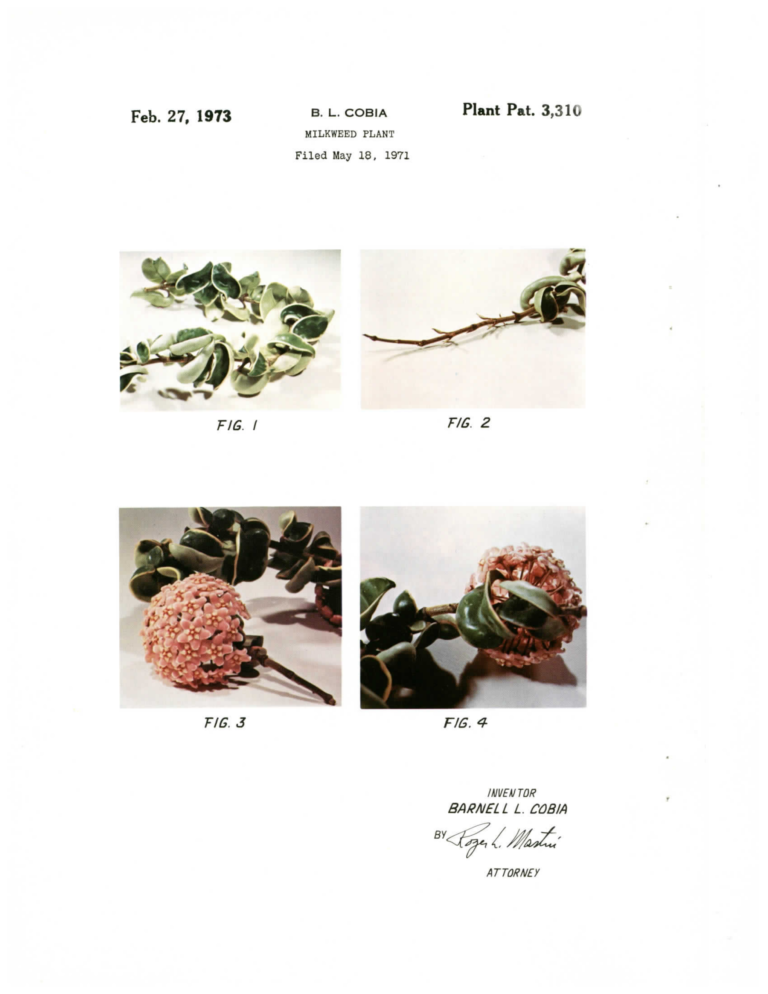 Marginalis - 1973 patent photographsView photo detailsClose photo details
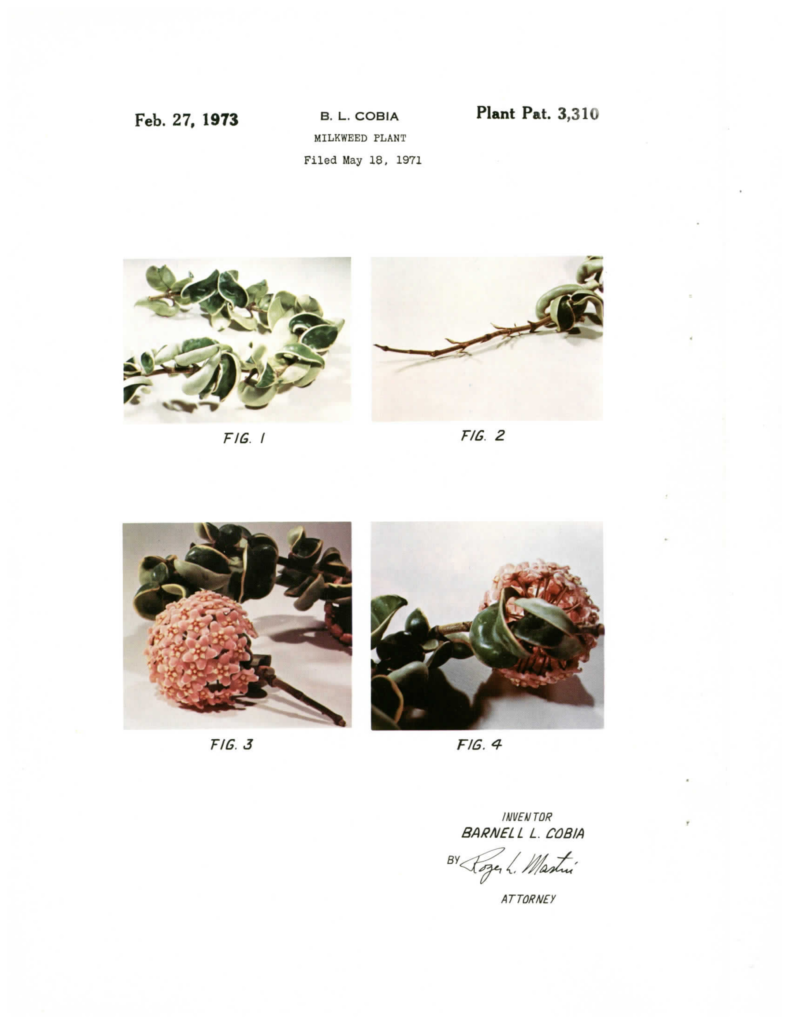
Image source · Rights and reuse terms
Complete photographic sheet of United States Plant Patent 3,310 (1973), with Figures 1–4 showing foliage, a vine tip, open flowers and a further view of an inflorescence. These depict historical patent material, not an authenticated modern accession. Printed context retained; native resizing only.
Photographer or creator: United States Plant Patent 3,310 (1973); individual photographer uncredited
Identification basis: Identification by the patent and its figure descriptions; no authenticated modern accession.
Rights and reuse: Faithful full patent-sheet facsimile under USPTO patent-information guidance. No separate open license asserted for isolated photographs.
Image record: IMG-000029
Evidence-Based Growing Insights
No form-specific care conclusion has passed review. The parent Hoya page remains the source for shared information; generic advice is not repeated here.
What We Know
- The Marginalis patent reports a sport on cultivated Compacta, followed by successive stem-cutting propagation at Winter Garden, Florida (cols. 1–2 / original PDF p. 2).
- The patent distinguishes green centres surrounded by pale borders on both leaf surfaces from the pale centres and green borders described for Mauna Loa. Young upper borders can show pink to orange-yellow tones that fade toward paler yellow or yellow-green as leaves age (cols. 1–4 / PDF pp. 2–3).
- The leaves are described as semisucculent, predominantly ovate to elliptic, folded along the midrib and variably curled. First-year mature blades are usually 30–70 mm long and 20–45 mm wide (cols. 3–4 / PDF p. 3).
- Umbels are described as usually containing 20–45 flowers, with flowers usually 12–18 mm across. The photographed patent material includes both unopened and open clusters; it does not establish a flowering schedule for unrelated modern plants (cols. 4–5 / PDF pp. 3–4; plate PDF p. 1).
- The Regalis patent identifies Regalis as a sport of Marginalis and emphasizes more persistent red-family colouring. Both applications were filed on 18 May 1971; their different February 1973 publication dates do not reverse that reported relationship (Regalis col. 2 / PDF p. 3; both patent headings).
- The 31 July 1973 Certificate of Correction supplies seven instructions affecting the issued text, including descriptive terms and a measurement. The corrected original controls over noisy OCR (original PDF p. 5).
- The registrar accepts Marginalis as an established cultivar name and explicitly acknowledges omitting it from the 2022 Stemma Compacta article. That omission is not evidence that Marginalis and Regalis were one cultivar (registrar Full Name and Status; Errors and Corrections).
- The 2025 nursery interview describes releases other than Krinkle 8 as natural mutations. This is retrospective testimony, rather than a cultivar-specific experiment or an accession log authenticating a modern plant (Stemma 7(1), p. 7).
- The patent’s examples were observed under fertilized, heavily shaded Florida nursery conditions. Ages, measurements and flower counts concern those specimens; they do not establish a controlled growth rate or form-specific care optimum (col. 5 / PDF p. 4).
What We Are Still Learning
Which living Marginalis accessions are traceable to the historical patent material?
What would help: Original nursery and acquisition labels, dated distribution records and a continuous propagation history.
How reliably can authenticated Marginalis and Regalis be separated across plant maturity?
What would help: Comparable leaves, stems and flowers from documented accessions, followed under recorded conditions through successive propagation cycles.
Which other outer-variegated Compacta labels represent the same material, and which represent separate selections?
What would help: Original naming records and traceable material histories; appearance or a descriptive selling label alone is insufficient.
Common Misconceptions
- An outer-variegated Compacta is not automatically the historical Marginalis clone.
- Pink new borders do not by themselves establish Regalis; the historical distinction includes the persistence and distribution of colour.
- The acknowledged omission from an earlier article does not invalidate the historical Marginalis name or merge it with Regalis.