Hoya carnosa
A climbing Hoya with fleshy leaves, white to pink-tinged flower clusters and a long history in cultivation.
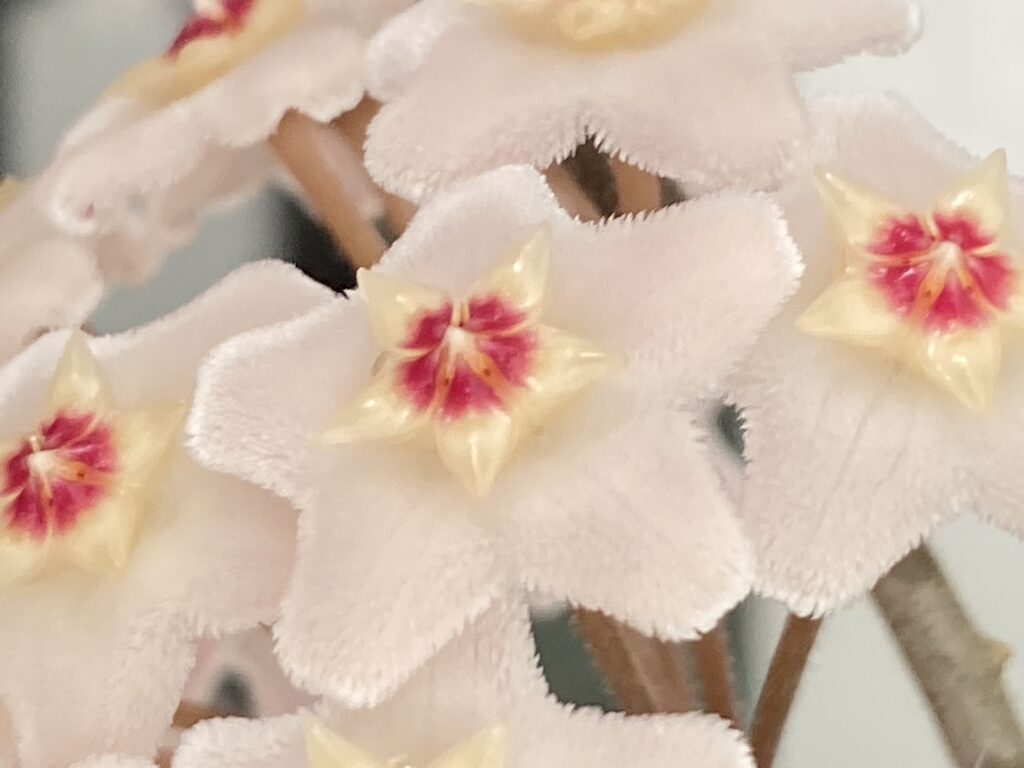
Photo details
Close view of flowers identified as Hoya carnosa by NC State Extension Plant Toolbox. No named cultivar is specified.
Photographer or creator: Kathleen Moore / NC State Extension Plant Toolbox
Reuse: CC BY 4.0 — https://creativecommons.org/licenses/by/4.0/; resized and EXIF-oriented by WordPress.
Identification: Identified as Hoya carnosa by NC State Extension Plant Toolbox; no named cultivar, voucher or accession supplied. Provider identification retained.
Overview
Hoya carnosa is a climbing plant with fleshy leaves and rounded clusters of white to pink-tinged flowers. Linnaeus the Younger first published its original name, Asclepias carnosa, in 1782. Its native range includes parts of southern China, mainland Southeast Asia, Taiwan and Japan. This page covers the regular green-leaved form; other cultivated forms have their own Growing Profiles.
Quick Facts
Taxonomic status
Kew accepts Hoya carnosa (L.f.) R.Br. as a species. This records Kew’s current taxonomic treatment; it does not authenticate cultivated plants carrying the name.
Name first published
Kew dates the original name, Asclepias carnosa L.f., to 1782 in Supplementum plantarum, page 170. The scanned title page bears 1781. Kew cites Brown’s combination in Hoya to 1810; the separate Asclepiadeae preprint remains uninspected.
Pronunciation
NC State Extension gives the English pronunciation HOY-ah kar-NO-suh. Capital letters mark the stressed syllables.
Source and scope
English pronunciation guide for the exact binomial; not a universal Latin convention.
Native region
Kew reports native presence in China South-Central, China Southeast, Hainan, Japan, Laos, Myanmar, Nansei-shoto and Taiwan. These are broad reporting regions; presence somewhere in a region does not establish occurrence throughout it.
Natural habitat
The Flora of China species treatment reports mountain forests, usually on trees, at 200–1,200 m. This is a regional flora account under its 1995 circumscription, not a verified elevation envelope across the whole current range.
Growth habit
The Flora of China treatment describes carnosa as an epiphytic climbing shrub: a woody plant that climbs and grows on another plant.
Leaves
Flora of China describes carnosa leaf blades 3.5–13 × 3–5 cm. These measurements belong to that regional treatment; they are not limits verified for every cultivated selection.
Sap / latex
Royal Botanic Gardens Victoria’s HortFlora describes clear latex in its Hoya carnosa treatment. That cultivated-plant account cites the earlier treatment as Hoya motoskei; this description should not be extended to every plant sold under a carnosa label.
Source and scope
The live carnosa entry cites the 2002 treatment as Hoya motoskei. Its cultivated-material circumscription is retained; not a claim about every plant carrying a carnosa label.
Flowers
Flora of China describes white, sometimes pink-centred corollas 1.5–2 cm across. This is the corolla measurement, rather than the diameter of the whole flower cluster.
Flora of China describes rounded flower clusters with about 30 flowers. This is a source description, not a fixed count for every cluster or cultivated plant.
Fragrance
The Royal Horticultural Society describes night-scented flowers. A specific scent such as chocolate, honey or vanilla is not established by that account.
What would you add?
Photo Gallery
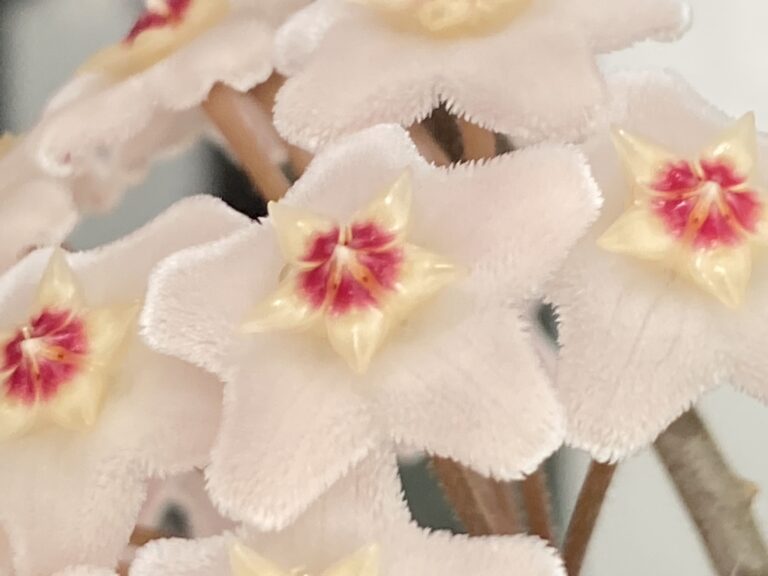 Hoya carnosa (provider identification)View photo detailsClose photo details
Close view of flowers identified as Hoya carnosa by NC State Extension Plant Toolbox. No named cultivar is specified.
Photo: Kathleen Moore / NC State Extension Plant Toolbox
Reuse: CC BY 4.0 — https://creativecommons.org/licenses/by/4.0/; resized and EXIF-oriented by WordPress.
Identification: Identified as Hoya carnosa by NC State Extension Plant Toolbox; no named cultivar, voucher or accession supplied. Provider identification retained.
Image source · Rights and reuse terms
Image record: IMG-000233
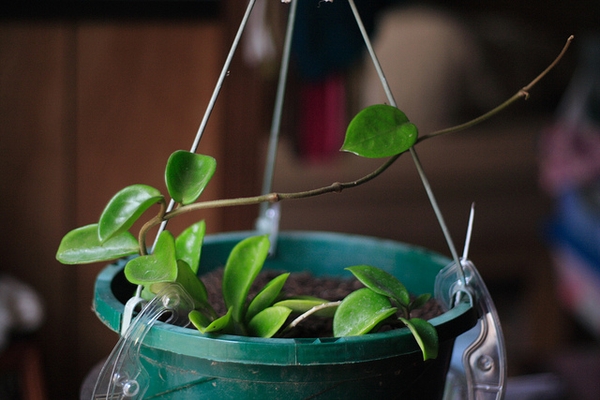 Hoya carnosa (provider identification)View photo detailsClose photo details
Young cultivated plant identified as Hoya carnosa by NC State Extension Plant Toolbox. The photograph shows green leaves and climbing stems; no named cultivar is specified.
Photo: saiberiac / NC State Extension Plant Toolbox
Reuse: CC BY 4.0 — https://creativecommons.org/licenses/by/4.0/; resized and EXIF-oriented by WordPress.
Identification: Identified as Hoya carnosa by NC State Extension Plant Toolbox; no named cultivar, voucher or accession supplied. Provider identification retained.
Image source · Rights and reuse terms
Image record: IMG-000234
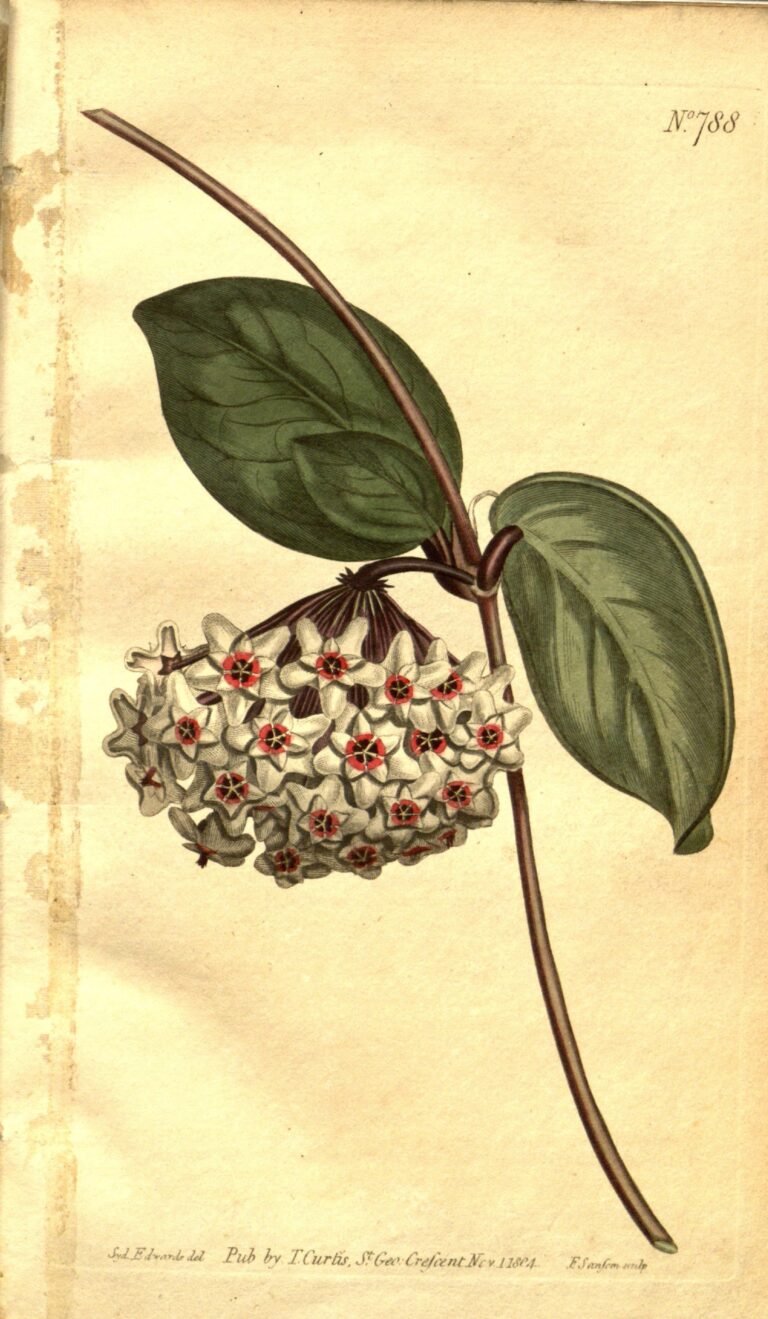 Historical botanical illustrationView photo detailsClose photo details
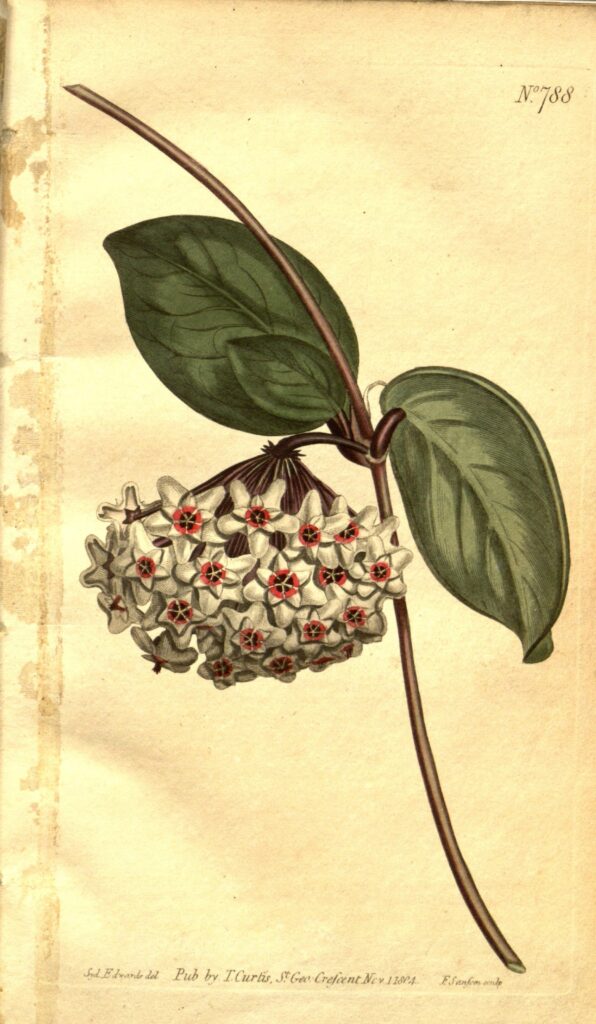
Historical botanical illustration, Curtis’s Botanical Magazine plate 788, catalogued as Hoya carnosa. The plate imprint reads 1 November 1804; repository metadata gives 1805 for the bound item. These dates are preserved separately. Display resized; no botanical or colour reconstruction.
Photo: Sydenham Edwards (drawing); F. Sansom (engraving); scan Biodiversity Heritage Library / Missouri Botanical Garden, via Wikimedia Commons
Reuse: CC BY 2.0; credit creator, link source and license, indicate changes.
Identification: Repository associates this historical plate with Hoya carnosa; no voucher or modern clone identity inferred.
Image source · Rights and reuse terms

Image record: IMG-000235
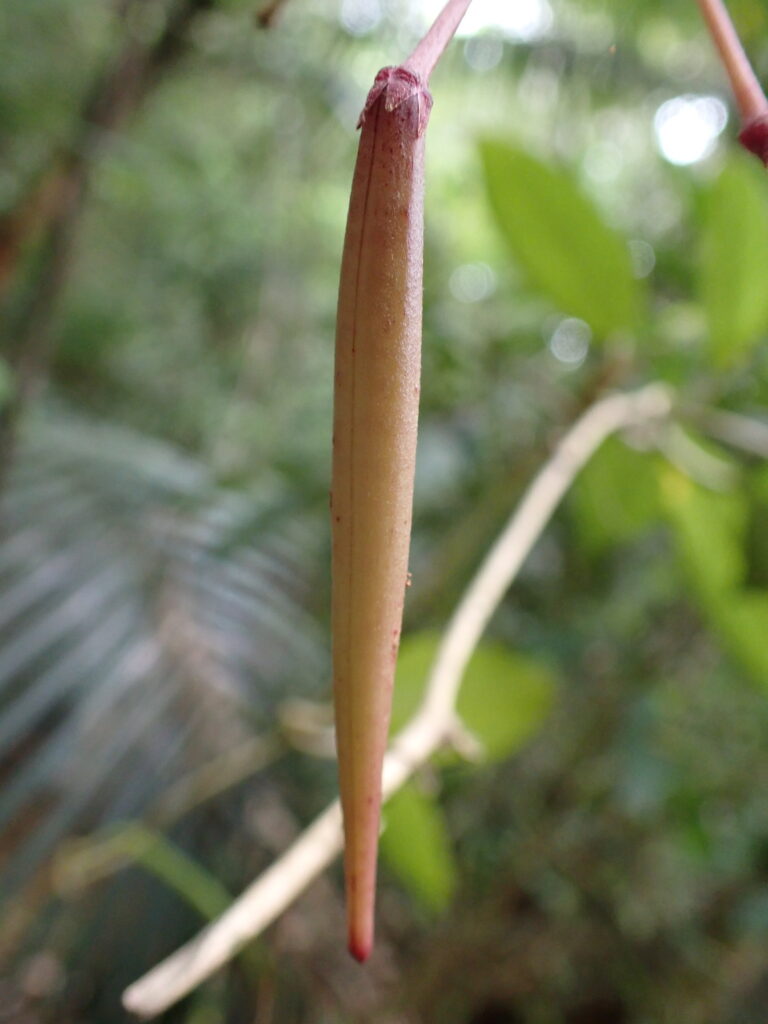 Fruit — IshigakiView photo detailsClose photo details
Fruit photographed in Ishigaki, Okinawa, on 18 July 2025 and identified as Hoya carnosa by its photographer. Wild or cultivated status is not specified. Public copy has location metadata removed and is resized and oriented for display.
Photo: M108t, via Wikimedia Commons
Reuse: CC BY 4.0; credit creator, link source and license, indicate changes.
Identification: Photographer identification; no independent voucher determination or wild-status confirmation.
Image source · Rights and reuse terms

Image record: IMG-000236
Growing Profiles
- Argentea Picta (historical)
- Argentea Picta (modern trade plant)
- Chelsea
- Compacta
- Compacta Mauna Loa
- Compacta Purple Leaf
- Exotica
- Freckles
- Holliana
- Hoya carnosa ‘Cream One’
- Hummel’s Krinkle Kurl
- Krinkle 8
- Krinkle 8 Variegata
- Little Leaf
- Little One
- Little Star
- Madara (Green Edge)
- Madara Snow Angel
- Manda’s Compacta
- Marginalis (Compacta)
- Pixie Krinkle
- Regalis (Compacta)
- Rubra
- Snow Ball
- Sweet One
- Tricolor
- Variegata
- Wilbur Graves
Evidence-Based Growing Insights
These notes report what a source or observation says, show what can reasonably be inferred, and keep the limits visible. They are not universal care promises.
Substrates and root development
Proposed takeaway: The trial supports differences in root development under its propagation conditions. It does not identify a universal potting mix or show that a rooting product is required.
Evidence, reasoning and ways to respond
Martínez Noguera and Velázquez Galeano (2026) compared eight substrates for stem cuttings from a commercial lot labelled carnosa. All treatments received the same rooting solution and were kept in a shaded microtunnel. Substrates differed significantly in longest-root length and root number; rooting percentage and fresh mass did not differ significantly.
Root length and root number differed significantly among substrates, while rooting percentage and fresh mass did not. The reported 100% establishment used rooted cuttings selected for transplanting as its denominator; it does not describe all initially planted cuttings.
When comparing propagation substrates, record the starting number of cuttings, rooting success and root development separately. Keep later transplant survival tied to the rooted cuttings actually transplanted.
Commercial lot labelled carnosa; eight substrate treatments, common rooting solution and shaded microtunnel at one study site. No cultivar authentication.
Controlled within-trial comparison with source-reported statistical testing. Transfer to other plant material, climates or household routines has not been established.
Plant identity, rooting-product formulation and single-site conditions limit broader advice. No watering schedule, hormone requirement or general substrate ranking is inferred.
What would you add?
Research
Where It Grows
Kew currently lists eight native reporting regions: China South-Central, China Southeast, Hainan, Japan, Laos, Myanmar, Nansei-shoto and Taiwan. It lists East Himalaya as doubtful, separately from the native range. Its six introduced regions are Bangladesh, Fiji, Korea, Solomon Islands, Sumatra and Trinidad–Tobago. These broad regions describe reported distribution and do not mean the species grows throughout each area.
Reported distribution
Native, introduced and doubtful records are shown separately, following Plants of the World Online.
Green: native. Amber: introduced. Blue hatching: doubtfully present. Grey provides geographic context.
Introduced records in the Pacific
All reported regions and map notes
Native (8): China South-Central; China Southeast; Hainan; Japan; Laos; Myanmar; Nansei-shoto; Taiwan.
Introduced (6): Bangladesh; Fiji; Korea; Solomon Islands; Sumatra; Trinidad–Tobago. The first five are mapped; Trinidad–Tobago is text-only.
Doubtfully present (1): East Himalaya.
Sumatra and Solomon Islands are display spellings for Kew’s Sumatera and Solomon Is. Introduced records do not establish native origin. A garden, supplier location or nursery label is not a wild collection record.
Distribution adapted from Kew Backbone Distributions (CC BY 3.0). Simplified TDWG WGSRPD reporting-unit outlines reuse the existing Library map geometry. The Asia and Pacific panels use different scales. Grey regions do not establish absence.
Natural Habitat
The 1995 Flora of China account describes Hoya carnosa as a climbing epiphytic shrub and places its regional species treatment in mountain forests, usually on trees, at 200–1,200 m. This is a regional flora account under its historical circumscription, rather than a complete habitat or elevation profile across the species’ present-day range.
Publication and naming history
The original description of Asclepias carnosa in Supplementum plantarum (p. 170) emphasises smooth, fleshy, ovate leaves and gives China as its origin. It also states that the author had seen only two leaves and a flowering umbel. That limited material matters when comparing the short description with later accounts. The scanned title page bears 1781; Kew cites the name as published in 1782.
In his 1810 Prodromus (p. 460), Robert Brown described carnosa with fleshy, oval-oblong leaves, hairy corollas and corona segments grooved underneath. He also cautioned that several species might have been confused under the name. The page cites his separate Wernerian paper; the two works should remain distinct in the naming history.
In the journal version of his Asclepiadeae paper (1811, pp. 26–27), Brown explains that he named Hoya for Thomas Hoy, whom he praised as a cultivator. He again suggests that carnosa may include several species and calls for comparison of living plants. This historical concern does not by itself resolve the identities of plants now sold under the name.
James Traill’s early Chiswick account (pp. 19–22) describes leaves mottled with whitish-green spots and fragrant flowers. He also reports ripe seed and a seed-raised plant with paler flowers and smaller, thinner leaves. These observations document variation in cultivated material; they do not identify today’s named selections.
Historical names explained
Asclepias carnosa L.f. is the original name on which the combination Hoya carnosa (L.f.) R.Br. is based. A change of genus does not, by itself, describe a different species. The original description and Brown’s Hoya account provide the historical evidence; the separate preprint date is explained in the Brown reference under Sources.
Traill’s account shows why historical synonym lists need care. Traill reports a re-examination by Brown of material received from Loureiro, consisting of a leafy branch and separate flowers. He questions whether these belonged to the same plant and rejects the earlier identification with carnosa. This is a historical disagreement about that material, rather than a new ruling on accepted synonymy.
The plant, leaves and flowers
The 1995 Flora of China treatment describes carnosa leaf blades measuring 3.5–13 × 3–5 cm. These dimensions belong to that regional treatment; they are not limits verified for every cultivated selection.
The same treatment describes rounded clusters of about 30 flowers. The corollas are white, sometimes pink-centred, and measure 1.5–2 cm across. That measurement is for an individual corolla, rather than the diameter of the whole flower cluster.
What Research Has Found
In Mochizuki, Furukawa and Kawakita’s 2017 field study, settling moths carried carnosa pollinaria on the adhesive pads of their legs. Observations on Amami-Oshima, Japan, during 2013–2015, combined visitor records with examination of moth legs and flower structures. The authors’ explanation concerns those studied populations; it does not demonstrate the pollinator of every carnosa population or every Hoya species.
The same paper contains a moth-name discrepancy between its results narrative and tables. We retain that as an unresolved source question. The presence of pollinaria on an insect and successful pollen deposition also have different denominators; neither should be presented as a seed-set percentage.
Kuang and colleagues (2025) produced a near-complete reference genome from material recorded as accession 20170662 at South China Botanical Garden, reportedly collected in Yangshan, Guangdong, in 2017. This gives researchers a genomic resource. It does not identify commercial cultivars or resolve their parentage. The paper does not supply a herbarium voucher or determination history for the accession.
Sources
Linnaeus filius — Supplementum plantarum (1781 title; cited 1782)
Carl Linnaeus the Younger (Linnaeus filius) · 1782 · Locator: Printed170 / Original PDF185; title PDF1
Brown (1810) — Prodromus: Hoya and Hoya carnosa
Robert Brown · 1810 · Locator: Hoya printed 459–460 / original PDF 327–328; carnosa printed 460 / PDF 328
Brown (1811 journal) — On the Asclepiadeae, Hoya account
Robert Brown · 1811 · Locator: Memoirs of the Wernerian Natural History Society1:12–78; inspected Hoya26–27 / Original PDF64–65
Traill (1827) — Hoya account and the australis name
James Traill · 1827 (Part I; completed bound volume dated 1830) · Vol. 7 · Locator: 16–30; Hoya australis p.28
Flora of China (1995) — Hoya account
Li Ping-tao; Michael G. Gilbert; W. Douglas Stevens · 1995 · Locator: Hoya account pp. 228–236; carnosa treatment 10 and varieties 10a–10b, reflowed genus PDF p. 4
Mochizuki, Furukawa and Kawakita (2017) — Pollinia transfer on moth legs
Ko Mochizuki; Saori Furukawa; Atsushi Kawakita · 2017 · Locator: American Journal of Botany 104(6): 953–960
Kuang and colleagues (2025) — Hoya carnosa reference genome
Yanfeng Kuang; Kunyue Ouyang; Meng Xia; Chao Feng; Ming Kang · 2025-07-12 · Locator: Scientific Data 12: 1210; article PDF pp. 1–6
Martínez Noguera and Velázquez Galeano (2026) — Carnosa cutting substrates
Mónica Elizabeth Martínez Noguera; Juan Manuel Velázquez Galeano · 2026-06-08 · Locator: Investigación Agraria 28(1): e2801850; PDF pp. 1–6
Kew — Hoya carnosa
Royal Botanic Gardens, Kew · Undated · Locator: Unpaginated;bounded fields accessed24October2026
NC State Extension — Hoya carnosa
NC State Extension · Undated; accessed 2026-10-24 · Locator: Phonetic Spelling
Royal Botanic Gardens Victoria — Hoya carnosa
Royal Botanic Gardens Victoria; treatment credited to P. Forster, D. Liddle and I. Liddle (2002) · Undated webpage; cited treatment 2002 · Locator: Unpaginated
Royal Horticultural Society — Hoya carnosa
Royal Horticultural Society · Undated; accessed 2026-10-24 · Locator: Species description beneath recommended plant categories
What We Still Do Not Know
What specimen or identification record verifies the identity of accession 20170662 used for the carnosa genome?
Why it matters: A genomic reference is tied to its sampled material. The paper does not provide a herbarium voucher or determination history for this accession.